When is a personal loan the right tool?
A personal loan can replace expensive, open-ended card debt with a cheaper, fixed payoff. It only works if the payment fits your budget and you don't run the cards back up. Here's how to tell, with the math worked out on a $12,000 example and the alternatives worth checking first.

A personal loan is a tool for swapping expensive, open-ended debt (or paying for a necessary one-time cost) for a cheaper payoff with a fixed end date. It works if the monthly payment fits your budget after your bills, and if you don't borrow again on the cards you just cleared. If either of those fails, the loan usually makes things worse.
Croft doesn't recommend lenders and earns nothing from them. This post is about the decision, not about where to apply.
What a personal loan actually is
A credit card is revolving credit. You have a limit, you can borrow, repay and borrow again, and the minimum payment shrinks as the balance shrinks, so there's no built-in finish line.
A personal loan is installment credit. You borrow a set amount once, usually at a fixed rate. Then you repay it in equal monthly payments over a set time, often two to five years. When the last payment clears, the debt is gone.
That structure is the whole point. A loan turns "pay something every month, indefinitely" into "pay this amount for 36 months, then stop."
Plenty of people use one. Americans owed a record $281 billion in unsecured personal loans in Q2 2026, across 33.3 million loans held by 26.9 million people. The average account balance was $8,437, and the average borrower owed $11,694 [17].
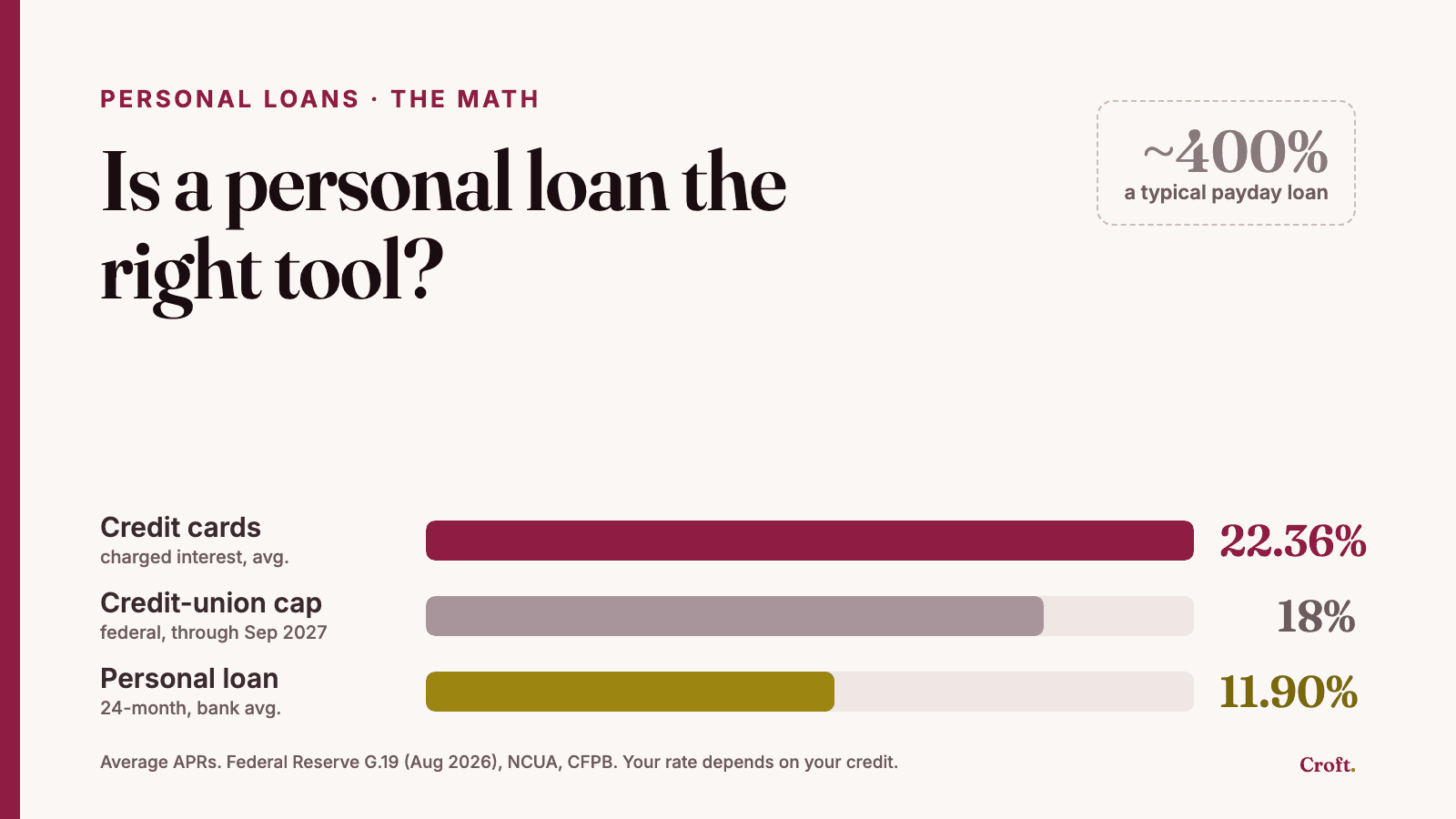
The price gap is real too. The Federal Reserve tracks average rates. For credit-card accounts that were charged interest, the average was 22.36%. For 24-month personal loans at banks, it was 11.90% (August 2026) [1]. The rate you'd actually get depends a lot on your credit score. LendingTree's Q2 2026 data shows average APRs of 15.69% for scores of 720 and up and 22.86% for 680–719. Below 660, every group averaged above 28% [2]. Bankrate puts the range across lenders at under 6% to almost 36% [3].
Average APR
Show data
| Average APR | |
|---|---|
| Credit cards | 22.36% |
| Credit-union cap | 18% |
| Personal loan | 11.9% |
When it makes sense
1. Consolidating high-APR cards at a meaningfully lower APR
This is the most common use. More than half (52.4%) of LendingTree users who took out a personal loan in Q2 2026 used it to pay off other debt. That's 42.4% to combine debts into one loan and 10.0% to pay off credit cards [2].
The test: the loan's total cost, fee included, has to come in well under what the cards would cost at the payment you can actually keep up.
Here's an illustrative example with round numbers:
Cards: $12,000 at 24% APR (2% a month), paying $400 a month.
Loan: 12% APR (1% a month), 36 months, with a 5% origination fee. That's a one-time charge for making the loan, taken out of the money you receive.
Because the fee comes off the top [4], you'd need to borrow $12,000 ÷ 0.95 = $12,631.58 to get $12,000 in hand. The fee is $631.58.
Using the standard loan-payment formula (borrowing $12,631.58 at 1% a month for 36 months), the payment comes to $419.55 a month.
| Cards at $400/month | 36-month loan |
|---|---|---|
Monthly payment | $400.00 | $419.55 |
Months to pay off | 47 | 36 |
Interest paid | $6,509.22 | $2,472.19 |
Origination fee | $0 | $631.58 |
Interest + fees | $6,509.22 | $3,103.77 |
Cards
$6,509.22
Interest, 47 months at $400
Loan
$3,103.77
$2,472 interest + $632 fee, 36 months
Saved with the loan$3,405.45
Show data
| Value | ||
|---|---|---|
| Cards | $6,509.22 | Interest, 47 months at $400 |
| Loan | $3,103.77 | $2,472 interest + $632 fee, 36 months |
| Saved with the loan | $3,405.45 |
The loan saves $3,405.45 and finishes 11 months sooner. The trade-off is a payment about $20 higher. If that $20 doesn't fit, the savings don't exist.
Show data
| Months | Cards ($400/mo) | Loan ($419.55/mo) |
|---|---|---|
| 0 | $12,000 | $12,632 |
| 1 | $11,840 | $12,338 |
| 2 | $11,677 | $12,042 |
| 3 | $11,510 | $11,743 |
| 4 | $11,341 | $11,441 |
| 5 | $11,167 | $11,136 |
| 6 | $10,991 | $10,828 |
| 7 | $10,811 | $10,516 |
| 8 | $10,627 | $10,202 |
| 9 | $10,439 | $9,884 |
| 10 | $10,248 | $9,564 |
| 11 | $10,053 | $9,240 |
| 12 | $9,854 | $8,913 |
| 13 | $9,651 | $8,582 |
| 14 | $9,444 | $8,248 |
| 15 | $9,233 | $7,911 |
| 16 | $9,018 | $7,571 |
| 17 | $8,798 | $7,227 |
| 18 | $8,574 | $6,880 |
| 19 | $8,346 | $6,529 |
| 20 | $8,112 | $6,175 |
| 21 | $7,875 | $5,817 |
| 22 | $7,632 | $5,456 |
| 23 | $7,385 | $5,091 |
| 24 | $7,132 | $4,722 |
| 25 | $6,875 | $4,350 |
| 26 | $6,613 | $3,974 |
| 27 | $6,345 | $3,594 |
| 28 | $6,072 | $3,210 |
| 29 | $5,793 | $2,823 |
| 30 | $5,509 | $2,431 |
| 31 | $5,219 | $2,036 |
| 32 | $4,924 | $1,637 |
| 33 | $4,622 | $1,234 |
| 34 | $4,315 | $827 |
| 35 | $4,001 | $415 |
| 36 | $3,681 | $0 |
| 37 | $3,354 | — |
| 38 | $3,022 | — |
| 39 | $2,682 | — |
| 40 | $2,336 | — |
| 41 | $1,982 | — |
| 42 | $1,622 | — |
| 43 | $1,254 | — |
| 44 | $880 | — |
| 45 | $497 | — |
| 46 | $107 | — |
| 47 | $0 | — |
Notice what the fee does to the real price. You only receive $12,000, but you make 36 payments of $419.55. That works out to an APR of about 15.6%, not 12%. The APR counts required fees like this one, so it's the number to compare [4].
2. A necessary one-time expense with no cheaper option
A car repair you need to get to work, or a medical bill the provider won't put on a payment plan. The test: the cost is real and unavoidable, you've already asked for an interest-free plan, and the alternative is a card at a higher rate.
3. Replacing a payday or other high-cost loan
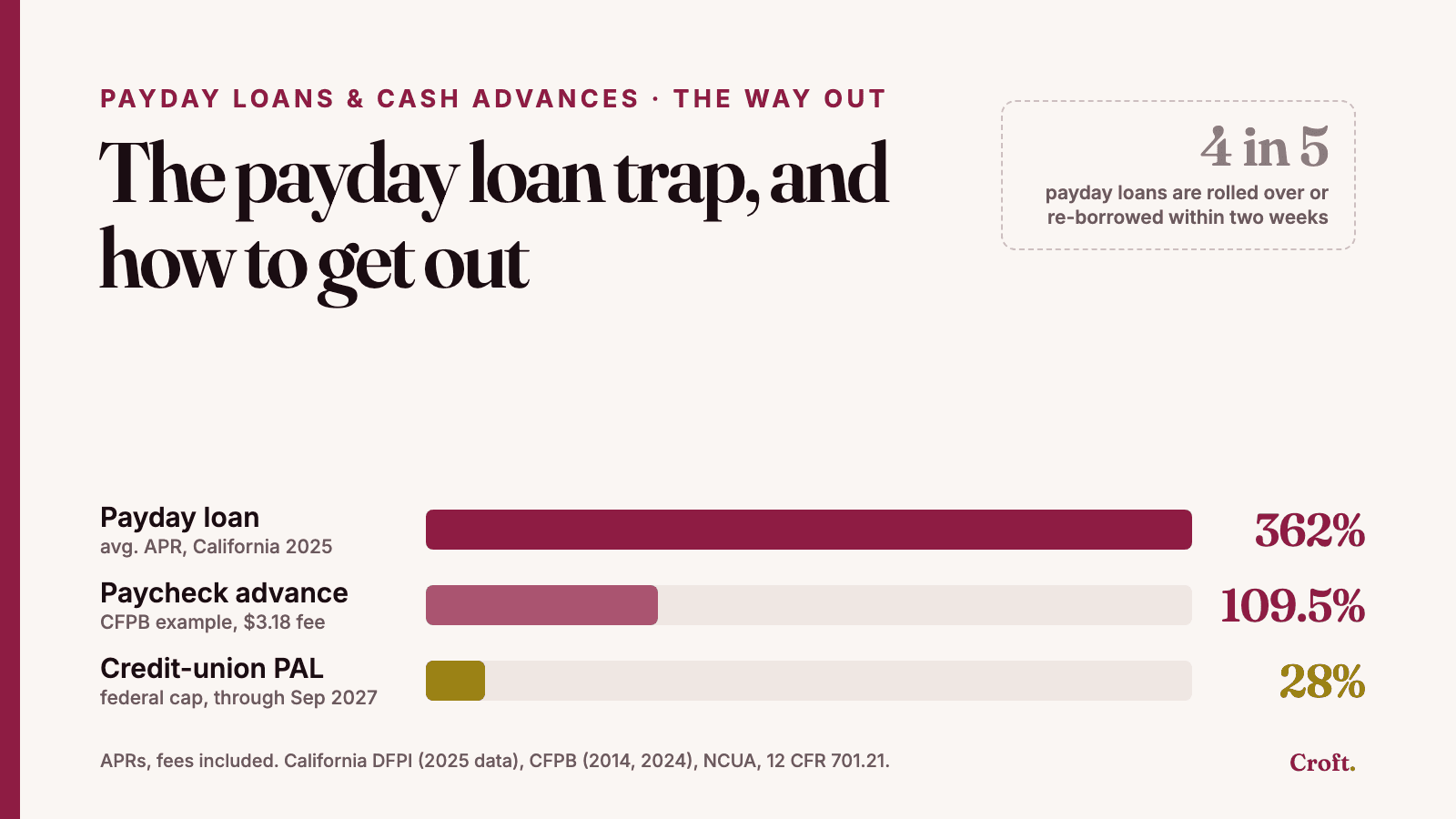
The CFPB notes that a typical $15 fee per $100 on a two-week payday loan works out to an APR of almost 400% [5]. Almost any mainstream personal loan beats that. The test: the new loan pays the old one off completely, and you won't need another payday loan next month to cover the gap.
4. Simplifying several debts you're already managing well
If you're paying everything on time but juggling five due dates, one fixed payment can lower the chance of a missed one. The test: the APR is no higher than what you pay now. Simplicity isn't worth paying extra interest.
5. Getting a fixed end date you'll actually keep
Some people pay down cards and then drift. A loan forces a schedule. The test: you've closed the gap that created the card debt in the first place, so the cards stay at zero.
When it doesn't
When you'll run the cards back up. This is the biggest risk, and there's data on it. TransUnion studied people who used a personal loan to pay off their cards. On average, their card balances dropped 57%. But for many of them, the balances climbed back close to where they started within 18 months [6]. Then you have the loan and the cards.
When a longer term only buys a smaller payment. Take the same $12,631.58 over 60 months. At 12% the payment drops to $280.98, but interest rises to $4,227.47, which is $1,755.28 more than the 36-month loan. At 18% over 60 months, interest plus the fee comes to $7,245.53. That's more than the $6,509.22 the cards would have cost, and it takes 13 months longer.
When it's for a want. A vacation or an upgrade becomes years of payments with interest on top. Save for it instead.
When the APR isn't meaningfully lower. If your offer is 22% and your cards average 24%, an origination fee can wipe out the difference. Do the math with the fee included.
When it's secured by something you can't afford to lose. Most personal loans are unsecured, but some are backed by a car or savings. A home-equity loan carries the most serious risk: if you don't pay it back, you could lose your home to foreclosure [7]. That turns credit-card debt, which can't take your house, into debt that can.
A 401(k) loan has its own catch. It usually has to be paid back within five years. If you leave your job and can't repay it, the rest is counted as income you owe tax on, and you may owe an extra 10% penalty too [8].
How to check if one fits
Compare total cost, not the monthly payment. Add up every payment over the full term and set it against what your current debt would cost at the payment you really make.
Include the origination fee. Fees typically run 1% to 10% of the loan amount and come out of what you receive [4]. Borrow enough to cover the debt after the fee, and compare APRs, which include it.
Make sure the payment fits after bills and a cushion. Start with your take-home pay, subtract rent, utilities, insurance and other fixed bills, and leave room for a normal month's surprises. If the payment only fits in a perfect month, it doesn't fit.
Have a plan for the cards. Keeping them open usually helps your credit history [9]. But decide now how you'll use them, if at all. And decide what you'll do the next time a bill runs over.
Choose the shortest term you can comfortably afford. Longer terms cost more in total, as the 60-month example shows. Many lenders don't charge a prepayment penalty, but some do, so confirm it in the loan terms before you sign [10].
What about your credit score? Applying adds a "hard inquiry" to your credit report. For most people that costs fewer than five points, and it only counts in FICO scores for a year [11]. Paying cards off with a loan brings the share of your card limits you're using (called utilization) down to 0%, which tends to help. The new account lowers the average age of your accounts at first [9]. In TransUnion's study, scores rose 18 points on average after paying off cards with a loan. People with good credit kept that gain over 18 months. People with weaker credit saw their scores fall back [6].
Alternatives worth comparing first
A 0% balance-transfer card. If you can pay the balance off within the promotional window, this can cost less than any loan. Expect a balance-transfer fee, usually a percentage of the amount moved, even on a 0% offer [12]. The promotional rate must last at least six months [13], and the rate afterward is what matters if you don't finish.
A credit-union personal loan. Federal credit unions are normally capped at 15% on loans. The NCUA has extended a temporary 18% ceiling through September 10, 2027 [14]. If your credit is fair, that cap can make a credit union worth checking.
A hardship plan from your card issuer. Call and ask whether they offer a lower rate or a payment plan for a stretch of hardship. There's no new account and no fee.
Nonprofit credit counseling and a debt management plan. A debt management plan isn't a loan. You make one monthly payment to a nonprofit agency (a member of the NFCC), and it pays your creditors for you. Many creditors lower interest or drop fees for people on a plan. Plans usually last 30 to 60 months [15]. The CFPB notes that these plans usually lower interest and fees. It also warns that some companies advertising them have defrauded people, so confirm that each creditor has accepted the plan before you send money [16].
The short version
A personal loan is the right tool when it costs clearly less in total, the payment fits a normal month, and the cards stay paid off. If you use Croft, ask Croft whether a personal loan is right for you. Try something like "Can I afford a $10,000 loan at 12% for 3 years?" It checks the payment against your real paychecks, bills and cushion, and shows what it does to your debt-free date. It won't point you to a lender.
Sources
Federal Reserve Board, G.19 Consumer Credit, release of October 7, 2026 (August 2026 rates: 24-month personal loans at commercial banks 11.90%; credit-card plans, all accounts 21.19%; accounts assessed interest 22.36%). https://www.federalreserve.gov/releases/g19/current/default.htm
LendingTree, "Personal Loan Statistics" (updated September 7, 2026; LendingTree user data, Q2 2026). https://www.lendingtree.com/personal/personal-loans-statistics/
Bankrate, "Average personal loan interest rates" (data as of October 21, 2026: average 12.55% for a 700 FICO, $5,000, three-year loan; lender range under 6% to almost 36%). https://www.bankrate.com/loans/personal-loans/average-personal-loan-rates/
Bankrate, "Personal loan origination fees: what to know" (August 11, 2025). https://www.bankrate.com/loans/personal-loans/personal-loan-origination-fees/
Consumer Financial Protection Bureau, "What is an annual percentage rate (APR), and why is it higher than the interest rate for my payday loan?" https://www.consumerfinance.gov/ask-cfpb/what-is-an-annual-percentage-rate-apr-and-why-is-it-higher-than-the-interest-rate-for-my-payday-loan-en-1625/
TransUnion, debt consolidation study (August 17, 2023; cohort April 2021 to September 2022). https://newsroom.transunion.com/debt-consolidation-aug2023/
Consumer Financial Protection Bureau, "What do I need to know about consolidating my credit card debt?" https://www.consumerfinance.gov/ask-cfpb/what-do-i-need-to-know-if-im-thinking-about-consolidating-my-credit-card-debt-en-1861/
IRS, "Retirement topics: plan loans." https://www.irs.gov/retirement-plans/plan-participant-employee/retirement-topics-loans
Experian, "Does debt consolidation hurt your credit?" (September 22, 2026). https://www.experian.com/blogs/ask-experian/can-debt-consolidation-affect-your-credit-score/
Experian, "How to avoid paying a prepayment penalty" (June 23, 2026). https://www.experian.com/blogs/ask-experian/how-to-avoid-paying-prepayment-penalty/
myFICO, "Credit checks and inquiries." https://www.myfico.com/credit-education/credit-reports/credit-checks-and-inquiries
Consumer Financial Protection Bureau, "What is a balance transfer fee? Can a balance transfer fee be charged on a zero percent interest rate offer?" https://www.consumerfinance.gov/ask-cfpb/what-is-a-balance-transfer-fee-can-a-balance-transfer-fee-be-charged-on-a-zero-percent-interest-rate-offer-en-53/
Consumer Financial Protection Bureau, "How long can I keep a low rate on a balance transfer or other introductory rate?" https://www.consumerfinance.gov/ask-cfpb/how-long-can-i-keep-a-low-rate-on-a-balance-transfer-or-other-introductory-rate-en-15/
NCUA, "NCUA Board extends loan interest rate ceiling" (February 6, 2026). https://ncua.gov/newsroom/press-release/2026/ncua-board-extends-loan-interest-rate-ceiling
National Foundation for Credit Counseling, "What is a debt management plan" and "Five benefits of a debt management plan." https://www.nfcc.org/resources/debt-management-plans/ and https://www.nfcc.org/blog/five-benefits-of-a-debt-management-plan/
Consumer Financial Protection Bureau, "What is credit counseling?" https://www.consumerfinance.gov/ask-cfpb/what-is-credit-counseling-en-1451/
TransUnion, Q2 2026 Credit Industry Insights Report press release, "More Americans Have Access to Credit While Debt Growth Has Moderated" (August 6, 2026; via GlobeNewswire). https://www.stocktitan.net/news/TRU/more-americans-have-access-to-credit-while-debt-growth-has-jllagbaxev22.html