Should you save up for a car or take a loan?
If your current car can last and you carry card debt, save first: clear the 24% card, then buy with cash or a big down payment. If you need a car now for work, a short, low-APR loan with money down is fine, as long as the payment fits your paycheck.

If your current car can keep going and you carry credit card debt, save first: clear the high-interest card, then buy with cash or a large down payment. If you need a car now to keep earning, a loan can be the right call, as long as the APR is reasonable, you put money down, the term is 60 months or less, and the payment fits your paycheck. Both answers can be right; the numbers below show which one is right for you.
What a car loan actually costs
Rates depend heavily on your credit and on whether the car is new or used. Experian's State of the Automotive Finance Market report for Q2 2026 put the average new-car loan at about 6.35% and the average used-car loan at about 11.19%. By credit tier, new-car rates ran from about 4.4% for the strongest scores to about 16% for the weakest; used-car rates from about 6.3% to about 21.6%. Federal Reserve data on 60-month new-car loans at commercial banks has been around 7.5%.
For the examples here we use 9% APR, roughly what a prime borrower pays on a used car or a near-prime borrower pays on a new one. Here is what $18,000 borrowed costs in total interest at a few rates:
5% APR: $2,380.93 over 60 months, $2,871.99 over 72
7% APR: $3,385.31 over 60 months, $4,095.54 over 72
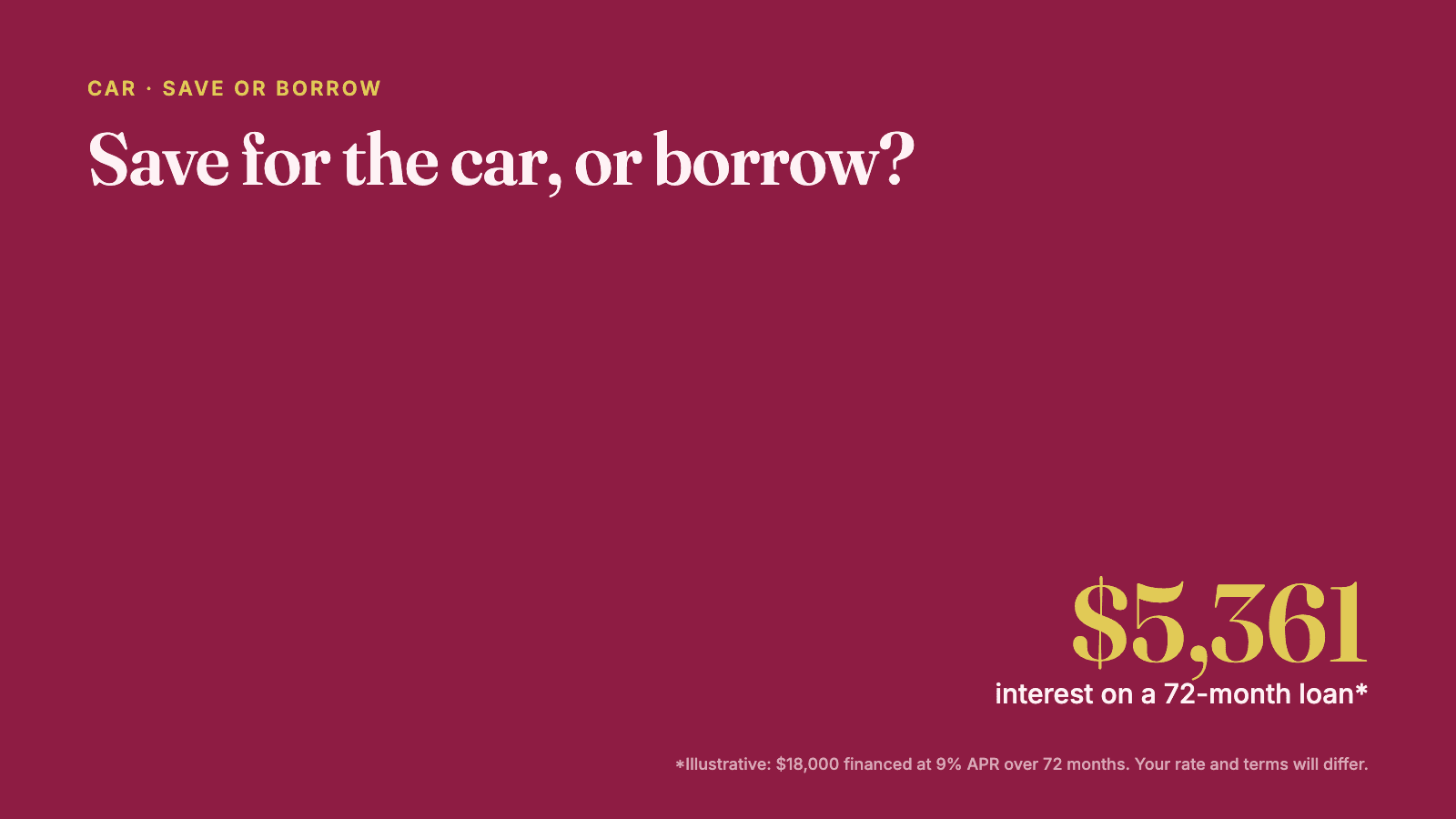
9% APR: $4,419.02 over 60 months, $5,361.06 over 72
12% APR: $6,023.99 over 60 months, $7,337.18 over 72
15% APR: $7,693.08 over 60 months, $9,403.93 over 72
A worked example: a $20,000 car
You have $2,000 saved and want a $20,000 car. Three ways to get there:
60-month loan at 9%, $2,000 down. You borrow $18,000. The payment is $373.65 a month. Total interest is $4,419.02, so you pay $22,419.02 on the loan, plus your $2,000 down.
72-month loan at 9%, $2,000 down. The payment drops to $324.46, only $49.19 less. Total interest rises to $5,361.06, which is $942.04 more for the same car.
Save $373.65 a month and pay cash. You need $18,000 more. At that pace it takes 49 months (48 deposits of $373.65 make $17,935.20; the 49th covers the last $64.80). You avoid all $4,419.02 of interest. A high-yield savings account at 3–4% would shorten that to about 45–46 months.
Total interest paid
Show data
| Total interest paid | |
|---|---|
| Save and pay cash | $0 |
| 60-month loan | $4,419.02 |
| 72-month loan | $5,361.06 |
| 84-month loan | $6,326.81 |
A bigger down payment helps twice. Put $5,000 down instead of $2,000 and the 60-month loan is $15,000: the payment falls to $311.38 and total interest to $3,682.46, saving $736.56. With nothing down, the same 60-month loan costs $415.17 a month and $4,909.99 in interest.
The risk of owing more than the car is worth
Cars lose value fast. Kelley Blue Book estimates many vehicles lose about 20% in the first year and around half or more within five years. Long loans pay down slowly at first, so the balance can sit above the car's value. Edmunds reported that about 30% of trade-ins toward new cars in early 2026 carried negative equity, averaging more than $7,000. If the car is totaled or you have to sell, you still owe the gap.
Show data
| Months after purchase | Car value (assumption) | $0 down, 72 months | $2,000 down, 60 months |
|---|---|---|---|
| 0 | $20,000 | $20,000 | $18,000 |
| 6 | $17,888.54 | $18,713.02 | $16,540.99 |
| 12 | $16,000 | $17,367.04 | $15,015.09 |
| 18 | $15,178.93 | $15,959.34 | $13,419.21 |
| 24 | $14,400 | $14,487.10 | $11,750.15 |
| 30 | $13,661.04 | $12,947.33 | $10,004.56 |
| 36 | $12,960 | $11,336.96 | $8,178.92 |
| 42 | $12,294.94 | $9,652.76 | $6,269.58 |
| 48 | $11,664 | $7,891.33 | $4,272.69 |
| 54 | $11,065.44 | $6,049.13 | $2,184.24 |
| 60 | $10,497.60 | $4,122.46 | $0 |
| 66 | $9,958.90 | $2,107.47 | — |
| 72 | $9,447.84 | $0 | — |
Waiting has a cost too
Saving only works if you can get by in the meantime. If your car is failing, the months of saving bring repair bills, rideshares and the risk of missing work. In our example, waiting 49 months avoids $4,419.02 of interest, which works out to about $90 a month. If keeping the old car running, or getting around without one, costs you more than about $90 a month beyond what owning the new car would, the loan is likely the cheaper path. If losing your ride would cost you your job, that settles it.
If you carry card debt, it comes first
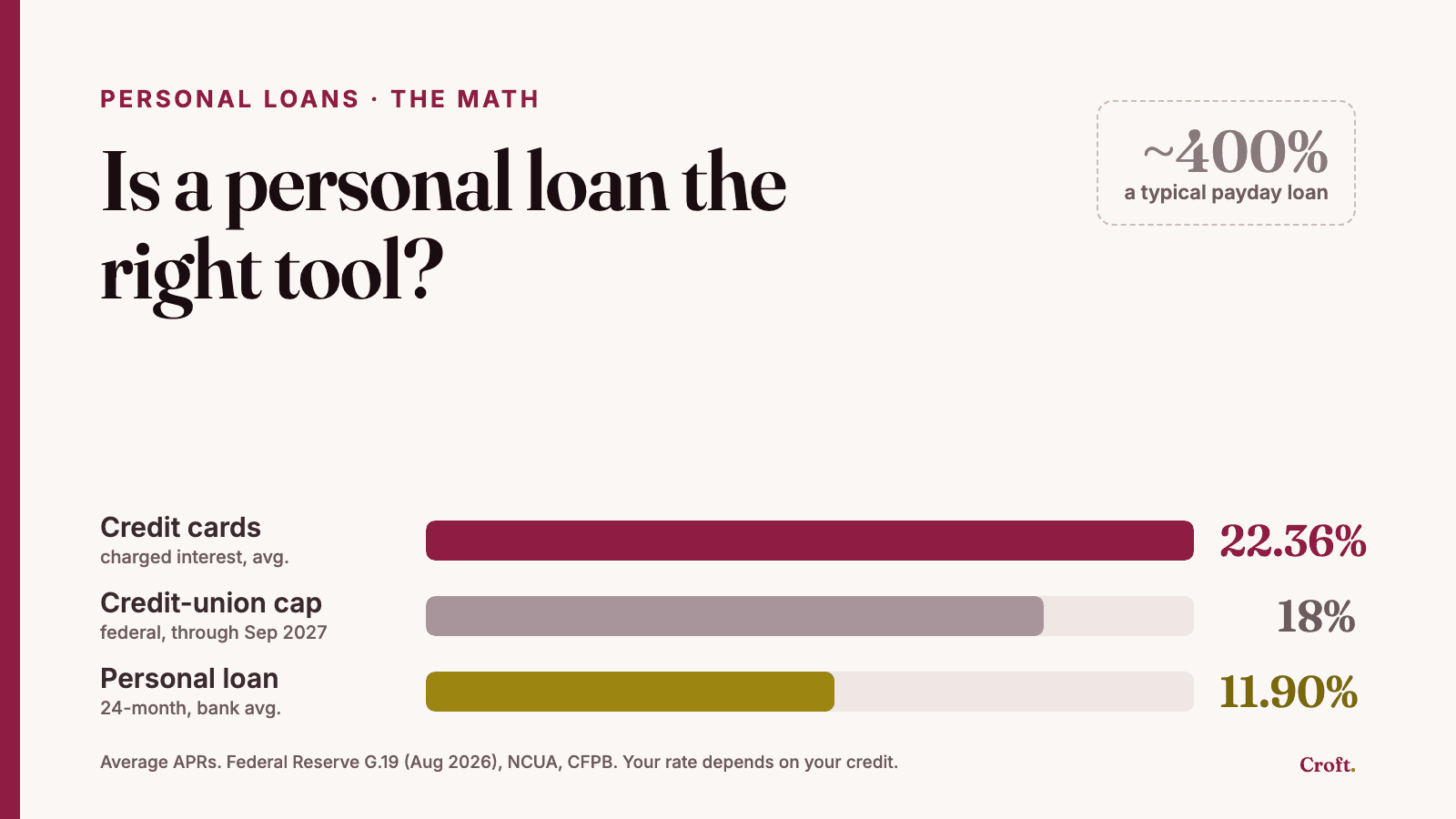
Federal Reserve data shows credit card accounts that are charged interest average around 22%. Money parked in a savings account for a future car earns a few percent while the card charges 20-something. Paying the card down first is usually the better deal, and it can raise your credit score before you apply, which may lower the car loan's rate.
Already have both? Say you have the $18,000 car loan above and a $5,000 card at 24%, paying $150 a month on the card, plus $200 extra each month. Sending the extra to the card first, then rolling everything into the car loan once the card is gone, costs $4,118.81 in total interest and clears both in 38 months. Sending the extra to the car loan first costs $5,505.75 and takes 40 months. The higher rate wins: $1,386.94 saved.
Extra to the 24% card first
$4,118.81
Total interest; both debts gone in 38 months
Extra to the 9% car loan first
$5,505.75
Total interest; both debts gone in 40 months
Saved by paying the card first$1,386.94
Show data
| Value | ||
|---|---|---|
| Extra to the 24% card first | $4,118.81 | Total interest; both debts gone in 38 months |
| Extra to the 9% car loan first | $5,505.75 | Total interest; both debts gone in 40 months |
| Saved by paying the card first | $1,386.94 |
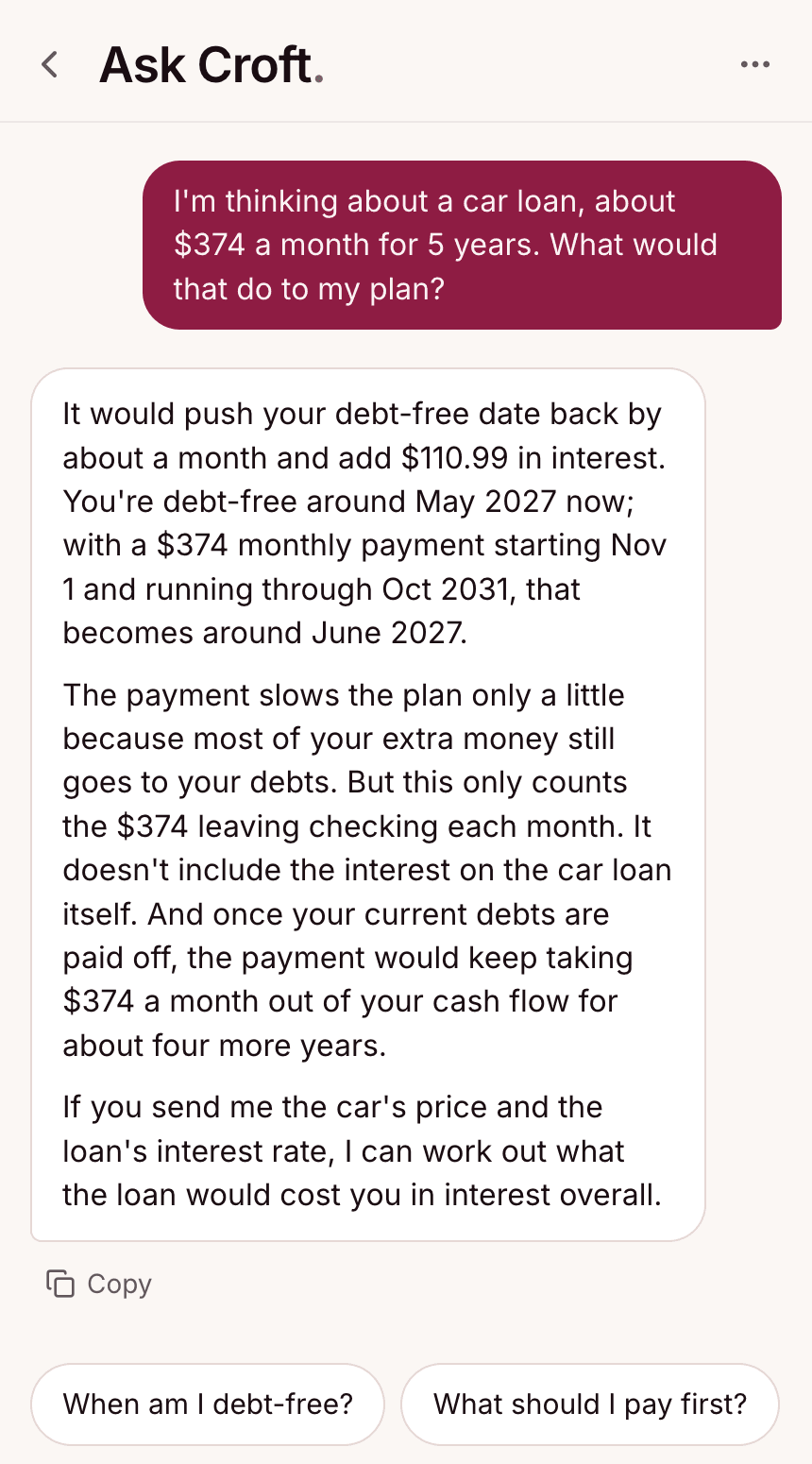
Or ask Croft. Ask Croft runs the numbers against your own plan: your paychecks, bills and debts. Here's what it said for a sample account with two credit cards and a student loan, asked about the $374 payment from the example above:
Decision checklist
Save first when
Your current car is reliable enough to wait, or you can get to work without one for now.
You carry high-interest debt, like a card at 20% or more. Clear that first.
The loan APR you're offered is high, roughly in the teens or above.
A loan can make sense when
You need the car now to keep earning.
The APR is low for your situation.
You can put money down and keep the term to 60 months or less.
The payment fits your paycheck math, after bills and minimums. Here's the safe-to-pay method.
The math you can do by hand
The monthly payment formula is: payment = loan × r ÷ (1 − (1 + r)^−n), where r is the APR divided by 12 and n is the number of months. For $18,000 at 9% over 60 months, r is 0.0075 and n is 60, which gives $373.65.
Or just use the bank's calculator, but always check the total interest: payment × number of months − amount borrowed. For the 60-month loan that's $373.65 × 60 − $18,000 ≈ $4,419 (the last payment adjusts by a few cents). A lower payment over more months almost always means more total interest.
If you do take a loan
Get pre-approved by a bank or credit union before you visit the dealer. The CFPB suggests comparing quotes from several lenders so you can negotiate from a known rate.
Compare the APR, not the payment. A dealer can hit almost any monthly payment by stretching the term.
Keep the term short, ideally 60 months or less, so you build equity faster.
Skip the add-ons you don't need. Extended warranties, credit insurance and extras rolled into the loan raise what you borrow and pay interest on. Negotiate them separately, if at all.
The short version: if you can wait, pay off the card, then save and buy with as much cash as you can. If you can't wait, borrow carefully, with money down, a short term, and a payment your paycheck can actually carry.