The payday loan and cash-advance trap, and how to get out
A payday loan or cash-advance app gets you to the next paycheck, then takes a big bite out of it, so you borrow again. Here's the math on a $400 loan and a $100 app advance, why it's hard to stop, and the steps that get you out, one loan at a time.

A payday loan or a cash-advance app gets you through to the next paycheck. The trap is what happens on that payday. The loan takes a big bite out of your pay, so you come up short again and borrow again. Each round costs a fee, and the fees never lower what you owe.
You can get out. It takes a list, one loan at a time, and a few plain questions to the people you owe. This post shows the math on a $400 loan and a $100 app advance, and then the steps.
Croft doesn't recommend lenders or apps, and it earns nothing from them. This post is about getting out, not about where to borrow.
What the trap is
A payday loan is a small, short loan. It's usually $500 or less, and it's due on your next payday, two to four weeks away. You give the lender a check dated for payday, or let them take the money out of your bank account. Payday lenders usually don't check whether you can repay it and still pay your other bills [1].
A cash-advance app (also called a paycheck advance or earned wage access) gives you part of your pay early. It takes the money back from your account on payday. Many of these apps say "no interest." Instead they charge a monthly membership, a fee to get the money fast, or ask for a "tip" [2].
Both can help in a real emergency, once. The trouble starts when one payday's repayment leaves too little to make it to the next one.
How it works: a $400 loan
Say you borrow $400 for two weeks. A typical fee is $15 for every $100 you borrow [3]. So on payday you owe $460: the $400 plus a $60 fee.
If you can't spare $460, the lender may let you roll over the loan. That means you pay just the $60 fee, and the $400 is due two weeks later, with another $60 fee. The fee doesn't lower what you owe [4]. Some states ban rollovers. But paying the loan off and taking out a new one the same day works the same way.
Here's what that $400 costs as it keeps going:
Loans in a row | Weeks | Fees paid | Still owed |
|---|---|---|---|
1 | 2 | $60 | $400 |
4 | 8 | $240 | $400 |
7 | 14 | $420 | $400 |
10 | 20 | $600 | $400 |
By the seventh loan, the fees are more than the $400 you borrowed. And you still owe the $400.
Show data
| Weeks | Fees paid so far | Still owed |
|---|---|---|
| 0 | $0 | $400 |
| 2 | $60 | $400 |
| 4 | $120 | $400 |
| 6 | $180 | $400 |
| 8 | $240 | $400 |
| 10 | $300 | $400 |
| 12 | $360 | $400 |
| 14 | $420 | $400 |
| 16 | $480 | $400 |
| 18 | $540 | $400 |
| 20 | $600 | $400 |
That $15 fee looks like 15%. But it's 15% for just two weeks. Over a full year, it works out to an annual percentage rate (APR) of about 391% [3]. The APR is the yearly cost of borrowing, with fees included. It's the number that lets you compare one kind of loan to another.
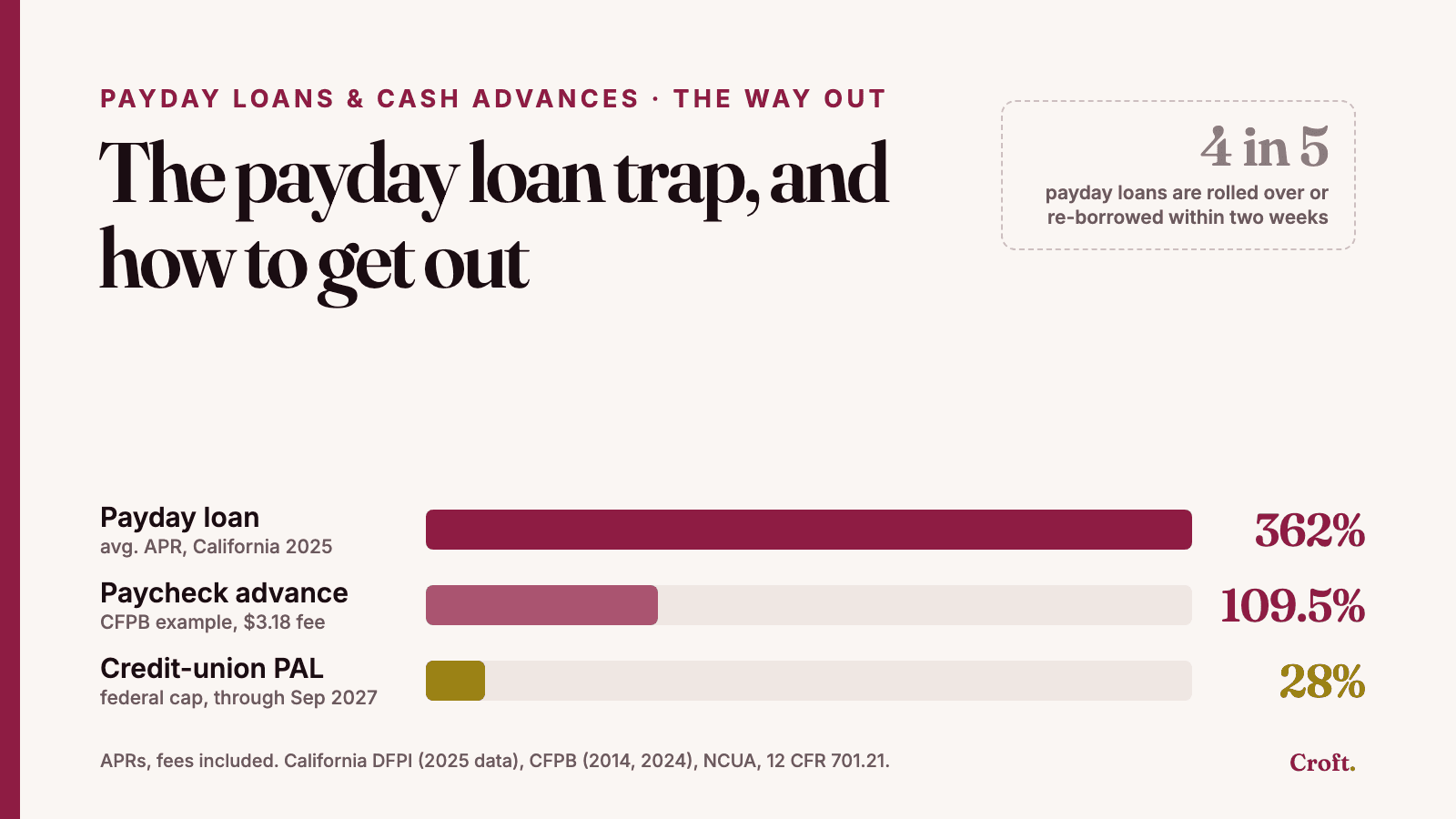
This isn't rare. When the Consumer Financial Protection Bureau (CFPB) studied payday loans, it found that more than 80% were rolled over or followed by a new loan within two weeks. About half of all loans were part of a run of 10 or more in a row [5]. Newer state data looks the same. In California in 2025, the average payday loan was $251, at an average APR of 362%. Of the repeat loans, 48.60% were made the same day the last one ended. And 75.41% of all the fees came from people who took out seven or more loans that year [6].
How it works: a cash-advance app
App costs are smaller per advance, so they're easy to miss. Here's an example with round numbers. The fees are in the range the CFPB found in app fee lists, but they're not any one app's prices [2].
A $9.99 monthly membership.
A $4.99 fee to get the money fast instead of in a few days.
You take a $100 advance every payday, twice a month, and it's paid back in 14 days.
That's $9.99 + $4.99 + $4.99 = $19.97 a month, or $239.64 a year, to keep borrowing $100 of your own pay.
As an APR, the $4.99 fast fee alone on $100 for 14 days is about 130%. Add each advance's half of the membership ($4.995) and it's about 260%.
The CFPB did the same math on real averages. A typical $106 advance with a $3.18 fee, paid back in 10 days, came to an APR of 109.5%. A $50 advance with the same fee for four days came to about 580%. In the CFPB's data, the average worker took 27 advances a year, about one every payday. Apps that ask for tips got one 73% of the time, and the average tip was $4.09 [2].
APR
Show data
| APR | |
|---|---|
| Credit cards, avg. (charged interest) | 22.36% |
| Credit-union PAL cap | 28% |
| Military Lending Act cap | 36% |
| Paycheck advance, CFPB example | 109.5% |
| Payday loan, California avg. 2025 | 362% |
| Payday loan, $15 per $100 for 2 weeks | 391.07% |
Why it's hard to stop
The fee isn't the biggest problem. The biggest problem is the whole repayment coming out of one paycheck.
Your rent, gas and groceries didn't get smaller. But your paycheck did, because part of it already went back to the lender. So you're short again, and the easiest fix is the same one as before. When one loan isn't enough, a second lender or a second app fills the gap. Then payday has more to pay back.
Here's an example of how that stacks up on a $1,200 paycheck, every two weeks:
Payday 1: nothing owed yet. You run short and take a $400 loan.
Payday 2: the loan takes $460. You have $740 left, so you borrow again and add two $100 app advances.
Payday 3: the loan ($460) and the two advances ($209.98 with fast fees) take $669.98. You have $530.02 left.
Payday 4: you added a $200 loan from a second lender ($230 due). Now $899.98 goes back, and $300.02 is left.
Left after paying back
Show data
| Left after paying back | |
|---|---|
| Payday 1: nothing owed yet | $1,200 |
| Payday 2: $400 loan due ($460) | $740 |
| Payday 3: + two $100 app advances | $530.02 |
| Payday 4: + a $200 loan from a second lender | $300.02 |
None of this means you did something wrong. These products are built to be paid back in one lump, out of a paycheck that's already spoken for. The CFPB found that only 15% of payday borrowers paid off all their loans when due without borrowing again within two weeks [5].
How to get out
You don't have to fix it all on one payday. The goal is to make each paycheck a little less spoken for than the last.
1. Write it all down
List every lender and app. For each one, write what you owe, the fee, and the day it takes the money.
2. Ask for an extended payment plan before the due date
Use these words: "I can't repay this in full. Do you offer an extended payment plan?" A plan splits what you owe into smaller payments over several months with no new fees. Of the 26 states that allowed payday loans in 2022, 16 made lenders offer one. Few borrowers used them [7]. The CFPB's example: on a $300 loan, eight rollovers over four months cost $360 in fees, and you'd still owe the $300. Choosing a plan at the first rollover would cost $345 in total [7]. Rules differ by state, so ask even if you're not sure.
3. Stop new advances one at a time, starting with the costliest
Pick the lender or app that costs the most per dollar. Pay it back and don't take another from it. Then move to the next one. Stopping all of them at once can leave you short on the first payday, and that pulls you right back in.
4. Cancel memberships you're not using
A monthly fee keeps charging even in a month you don't borrow. Cancel it in the app once that advance is paid back.
5. Look at a credit union payday alternative loan (PAL)
Federal credit unions can offer PALs. A PAL I is $200 to $1,000 for one to six months, and you have to be a member for one month first. A PAL II is up to $2,000 for one to 12 months, with no wait. You pay it back in set payments, there are no rollovers, and the application fee is capped at $20 [8]. The rate can be at most 10 points above the federal credit union cap [8]. That cap is 18% through September 10, 2027 [9], so a PAL tops out at 28%. Using one to pay off a payday loan swaps one payday-sized payment for smaller monthly ones.
6. Talk to a nonprofit credit counselor
Counselors can help you build a budget and a plan for your debts, often for free or at low cost. You can find one through the National Foundation for Credit Counseling (NFCC) or the Financial Counseling Association of America [10].
7. Protect your bank account
When a lender tries to take money that isn't there, your bank can charge you for it. In a CFPB study of online payday loans, half of borrowers had at least one lender withdrawal that overdrew the account or bounced. Those borrowers paid an average of $185 in bank fees over 18 months [15]. You have the right to stop a company's automatic payments, even if you agreed to them before. Tell the lender and your bank, in writing. This doesn't cancel what you owe, so set up another way to pay [11].
8. Build a small buffer, a little at a time
Each loan you stop frees up its fee. Put that money aside. Even a small cushion can cover the next surprise without a new advance.
Know the limits that protect you
If you're on active duty, or a covered family member of someone who is, the Military Lending Act caps most loans, payday loans included, at a 36% military APR, fees included [12]. As of 2023, about 20 states and Washington, D.C., had laws that cap payday loan rates at around 36% or limit them in other ways [13]. If something seems wrong with a loan, you can file a complaint with your state regulator or the CFPB [3].
What to try next time
Ask the bill for more time first. Call the company you owe and ask for a payment plan or a later due date. It costs nothing to ask.
Ask about a PAL at a credit union you belong to, or could join, before you need it.
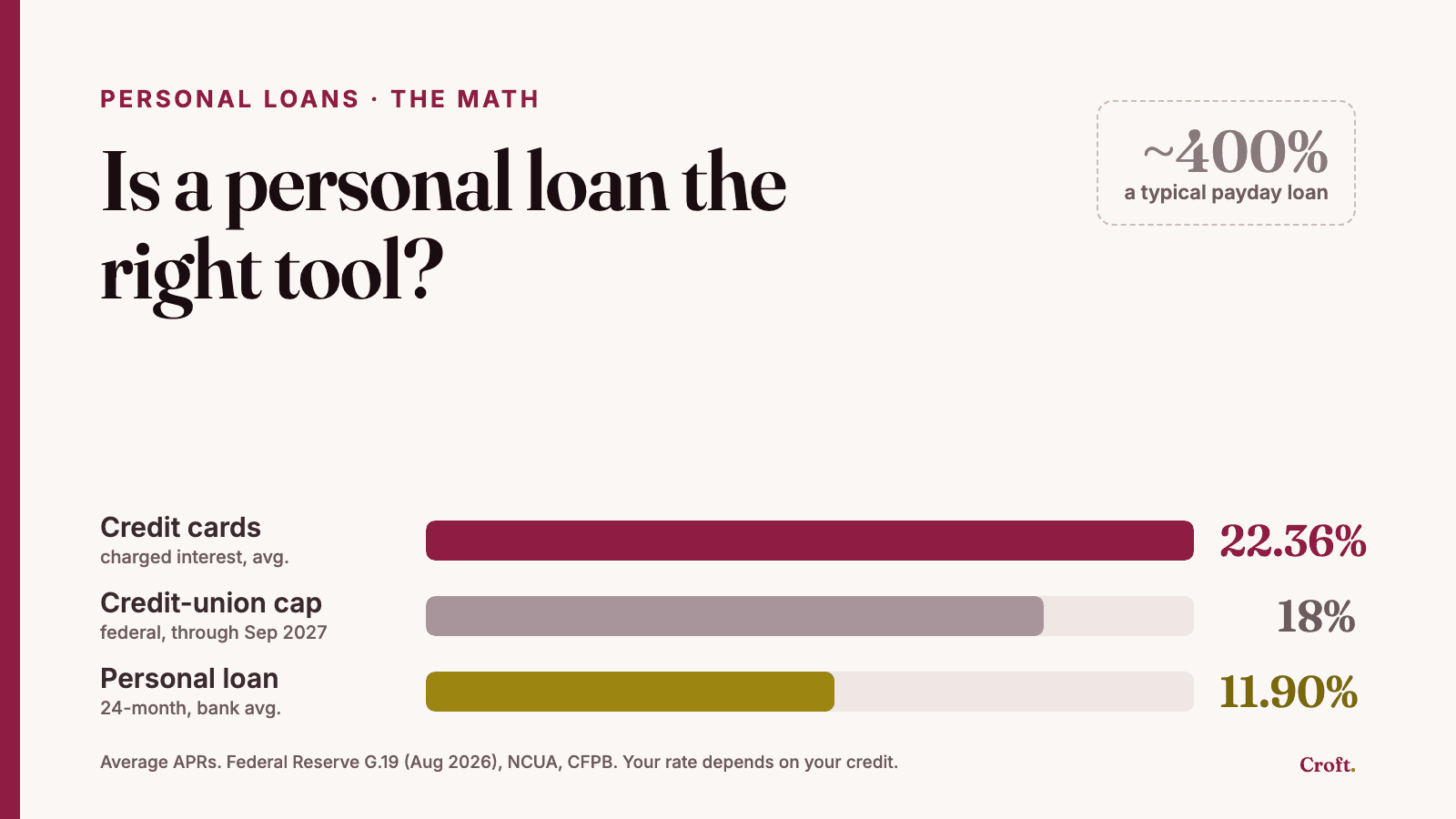
Compare by APR. Credit card plans that charged interest averaged 22.36% in August 2026 [14]. That's high, but it's far below a payday loan.
Keep a buffer, even a small one, set aside just for surprises.
Does this sound like you?
You take an advance or a payday loan on most paydays.
You've paid a fee just to push back a due date.
You use more than one lender or app.
Payday goes mostly to paying back what you borrowed.
You're paying a monthly membership to get your own pay early.
If you checked two or more, it's worth making the list in step 1 this week.
The short version
The trap isn't one loan. It's paying the whole thing back out of one paycheck, then borrowing again to get to the next. Write it all down, ask for a payment plan, and stop the costliest advance first.
If you use Croft, ask Croft: "What are my loans and cash-advance apps costing me each month?" Croft can spot short-term lenders and cash-advance apps in your bank history and add up what they cost each month. It won't point you to a lender.
Sources
Consumer Financial Protection Bureau, "What is a payday loan?" (last reviewed May 28, 2024). https://www.consumerfinance.gov/ask-cfpb/what-is-a-payday-loan-en-1567/
Consumer Financial Protection Bureau, "Data Spotlight: Developments in the Paycheck Advance Market" (July 18, 2024; data from 2021 and 2022). https://www.consumerfinance.gov/data-research/research-reports/data-spotlight-developments-in-the-paycheck-advance-market/
Consumer Financial Protection Bureau, "What is an annual percentage rate (APR), and why is it higher than the interest rate for my payday loan?" https://www.consumerfinance.gov/ask-cfpb/what-is-an-annual-percentage-rate-apr-and-why-is-it-higher-than-the-interest-rate-for-my-payday-loan-en-1625/
Consumer Financial Protection Bureau, "What does it mean to renew or roll over a payday loan?" (last reviewed November 25, 2024). https://www.consumerfinance.gov/ask-cfpb/what-does-it-mean-to-renew-or-roll-over-a-payday-loan-en-1573/
Consumer Financial Protection Bureau, "CFPB Finds Four Out Of Five Payday Loans Are Rolled Over Or Renewed" (March 25, 2014). https://www.consumerfinance.gov/about-us/newsroom/cfpb-finds-four-out-of-five-payday-loans-are-rolled-over-or-renewed/
California Department of Financial Protection and Innovation, "Annual Report of Payday Lending Activity Under the California Deferred Deposit Transaction Law," 2025 (calendar-year 2025 data). https://dfpi.ca.gov/wp-content/uploads/2026/08/DFPI-Annual-Report-CDDTL-2025.pdf
Consumer Financial Protection Bureau, "CFPB Finds Payday Borrowers Continue to Pay Significant Rollover Fees Despite State-Level Protections and Payment Plans" (April 6, 2022). https://www.consumerfinance.gov/about-us/newsroom/cfpb-finds-payday-borrowers-continue-to-pay-significant-rollover-fees-despite-state-level-protections-and-payment-plans/
12 CFR 701.21(c)(7)(iii) and (iv), payday alternative loans (PALs I and PALs II), via Cornell Legal Information Institute. https://www.law.cornell.edu/cfr/text/12/701.21
NCUA, "NCUA Board Extends Loan Interest Rate Ceiling" (February 6, 2026). https://ncua.gov/newsroom/press-release/2026/ncua-board-extends-loan-interest-rate-ceiling
Consumer Financial Protection Bureau, "What is credit counseling?" (last reviewed October 28, 2026). https://www.consumerfinance.gov/ask-cfpb/what-is-credit-counseling-en-1451/
Consumer Financial Protection Bureau, "How do I stop automatic payments from my bank account?" (last reviewed August 28, 2026). https://www.consumerfinance.gov/ask-cfpb/how-do-i-stop-automatic-payments-from-my-bank-account-en-2023/
Consumer Financial Protection Bureau, "What is covered under the Military Lending Act?" https://www.consumerfinance.gov/ask-cfpb/what-is-covered-under-the-military-lending-act-en-1785/
Center for Responsible Lending, "New CRL Map Shows Excessive Payday Lending Interest Rates Still Plague Over Half of U.S. States" (June 12, 2023). https://www.responsiblelending.org/media/new-crl-map-shows-excessive-payday-lending-interest-rates-still-plague-over-half-us-states
Federal Reserve Board, G.19 Consumer Credit, release of October 7, 2026 (August 2026: credit card plans, accounts assessed interest, 22.36%). https://www.federalreserve.gov/releases/g19/current/default.htm
Consumer Financial Protection Bureau, "Online Payday Loan Payments" (April 2016; 2011–2012 data, 18 months). https://files.consumerfinance.gov/f/201604_cfpb_online-payday-loan-payments.pdf