What's safe to spend before payday (and how to know any time)
Your bank balance isn't what you can spend. Here's the simple math for what's actually safe before your next paycheck, a worked example, and why the low point before payday matters most.

You open your banking app and see $1,240. It feels like a lot. Then the phone bill comes out, the car insurance hits, and by Thursday you're watching every swipe.
The balance wasn't wrong. It just wasn't answering the question you had. Your balance tells you what's in the account. It doesn't tell you what's already promised to someone else before your next paycheck arrives.
You're not alone in this. In the Federal Reserve's latest survey of household finances, only 63% of adults said they'd cover a surprise $400 expense with cash or its equivalent. That leaves more than a third of people who would need to borrow, sell something, or couldn't cover it at all. [1]
Your balance vs. what's safe to spend
"Safe to spend" is what's left after you take out everything that has to happen before payday. That means:
Spending that hasn't posted yet. The card swipe from last night may not show up for a day or two, but the money is gone.
Bills due before your next paycheck. Only the ones that land before payday. Next week's rent comes out of next week's paycheck.
Minimum payments due before payday. A missed minimum can mean a late fee.
Day-to-day spending until payday. Groceries, gas, the things you'll buy anyway.
A small cushion. Enough that one surprise doesn't push you below zero.
A worked example
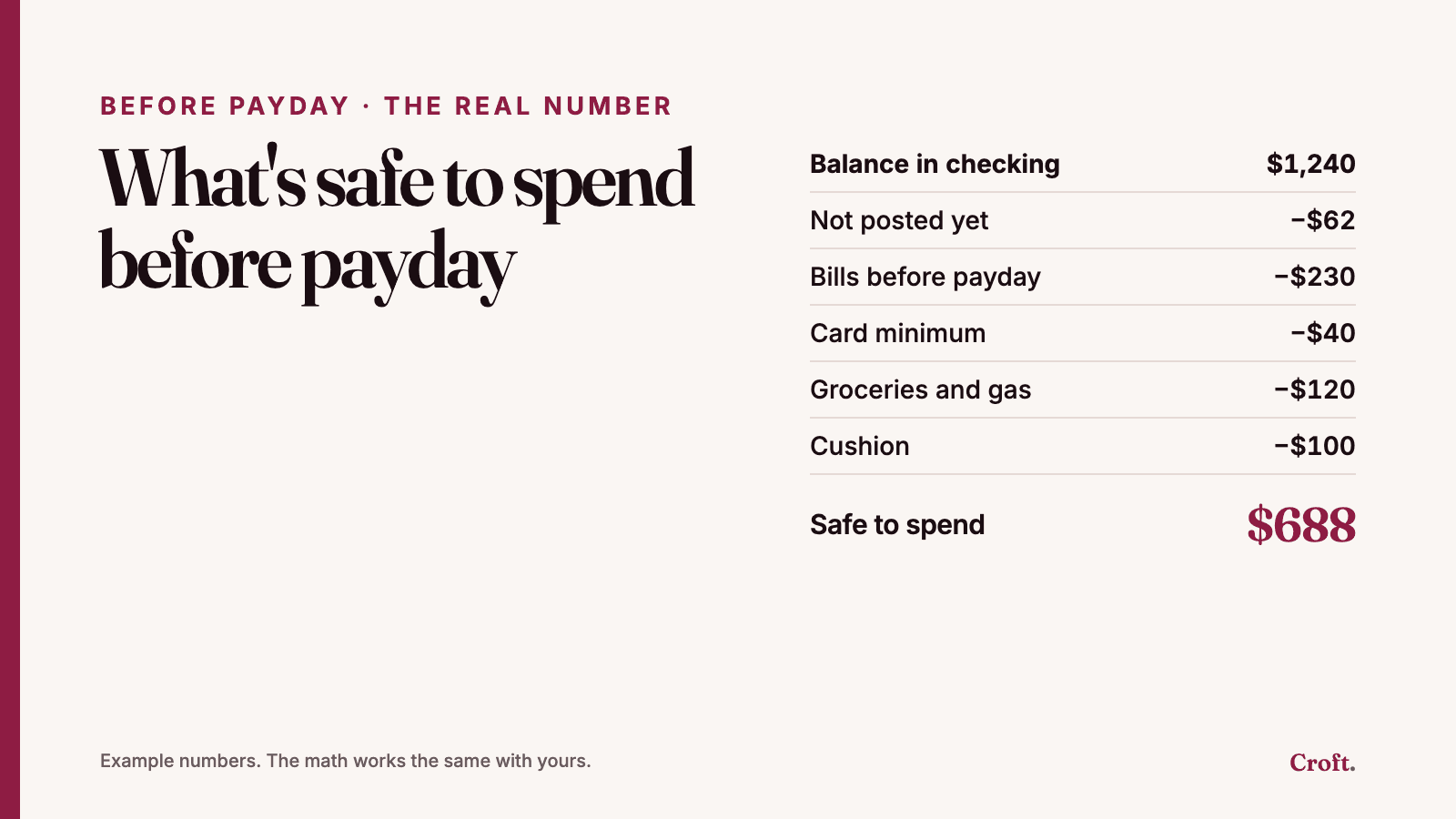
Say it's Monday, you have $1,240 in checking, and you get paid Friday. Here's what's coming before then. These are example numbers.
What | Amount |
|---|---|
Balance in checking | $1,240 |
Card purchase that hasn't posted yet | −$62 |
Phone bill, due Wednesday | −$85 |
Car insurance, due Thursday | −$145 |
Credit card minimum, due Thursday | −$40 |
Groceries and gas until Friday | −$120 |
Cushion for surprises | −$100 |
Safe to spend before payday | $688 |
Same account, same day. The balance says $1,240. The honest answer is $688.
Watch the low point, not just payday
Bills don't wait politely for each other. If rent comes out on Wednesday and your paycheck lands Friday, your balance on Thursday night might be much lower than it will be on Friday. That lowest point is the number that matters. If it dips below zero, you can pay an overdraft fee even if you're fine by Friday.
So when you check, ask two questions. What's safe to spend? And how low will my balance get before payday?
How to work it out yourself
Start with your checking balance.
Subtract anything you've spent that hasn't posted yet.
List every bill and minimum payment due before your next paycheck, with its date.
Subtract a realistic amount for groceries, gas and everyday spending until payday.
Keep a cushion. Even $50 to $100 helps.
Walk the days in order and find the lowest point.
It works. The hard part is that the answer changes every time money moves. A refund lands, a bill goes up, a payment posts early, and the number you worked out this morning is already out of date.
The short version
Your balance is what you have. Safe to spend is what you have minus what's already promised. Know the second number, keep an eye on the low point, and payday stops being a rescue.
Source: [1] Board of Governors of the Federal Reserve System, [Economic Well-Being of U.S. Households in 2025](https://www.federalreserve.gov/newsevents/pressreleases/other20260513a.htm), May 13, 2026.