Kids' costs, planned per paycheck
Most kid costs aren't random. Sports seasons, camps, school costs and child care come on dates you can see coming. Here's how to spread them across your paychecks, a $900 example, what the same $900 costs on a 22% card, and what to do when a season doesn't fit.

Kids cost a lot, and they cost it in lumps. A sign-up fee here, a tournament weekend there. Then school photos, a birthday party and new cleats, all in the same two weeks.
Child care alone is a big line. In the Federal Reserve's latest survey of U.S. households, the median monthly child care payment was $1,083 among parents who paid for child care. That's over half of the $1,900 median housing payment for families who paid for both. [[1]](https://www.federalreserve.gov/publications/files/2025-report-economic-well-being-us-households-202605.pdf)
Sports add more. The Aspen Institute's Project Play found the average sports family spent $1,016 on one child's main sport in 2024, up 46% since 2019. Counting that same child's other sports, it came to nearly $1,500 for the year. [[2]](https://projectplay.org/news/2025/2/24/project-play-survey-family-spending-on-youth-sports-rises-46-over-five-years)
None of this is a reason to feel bad. It's a reason to plan. Most kid costs show up on dates you can see months ahead. This post shows how to spread them across your paychecks, so they don't land on a credit card.
Why kid costs feel random (and mostly aren't)
Kid costs feel random for three reasons:
They're lumpy. Rent is the same every month. A fall season fee comes once, and it's big.
They cluster. August brings school supplies, clothes and fall sign-ups at once. December brings the holidays. Spring brings sign-ups again, plus camp deposits.
They come in pieces. The fee is just the start. Then come the uniform, the tournament entry, the hotel, the gas and the team dinner.
But the dates repeat. The fall season starts around the same time every year. Camp sign-ups open around the same week. School photos come every fall. Birthdays don't move.
Once you write the dates down, most of the surprise goes away. What's left is the true surprise: the broken glasses, the extra tournament nobody planned. That's what a cushion is for.
Example: a $900 tournament season over three paychecks
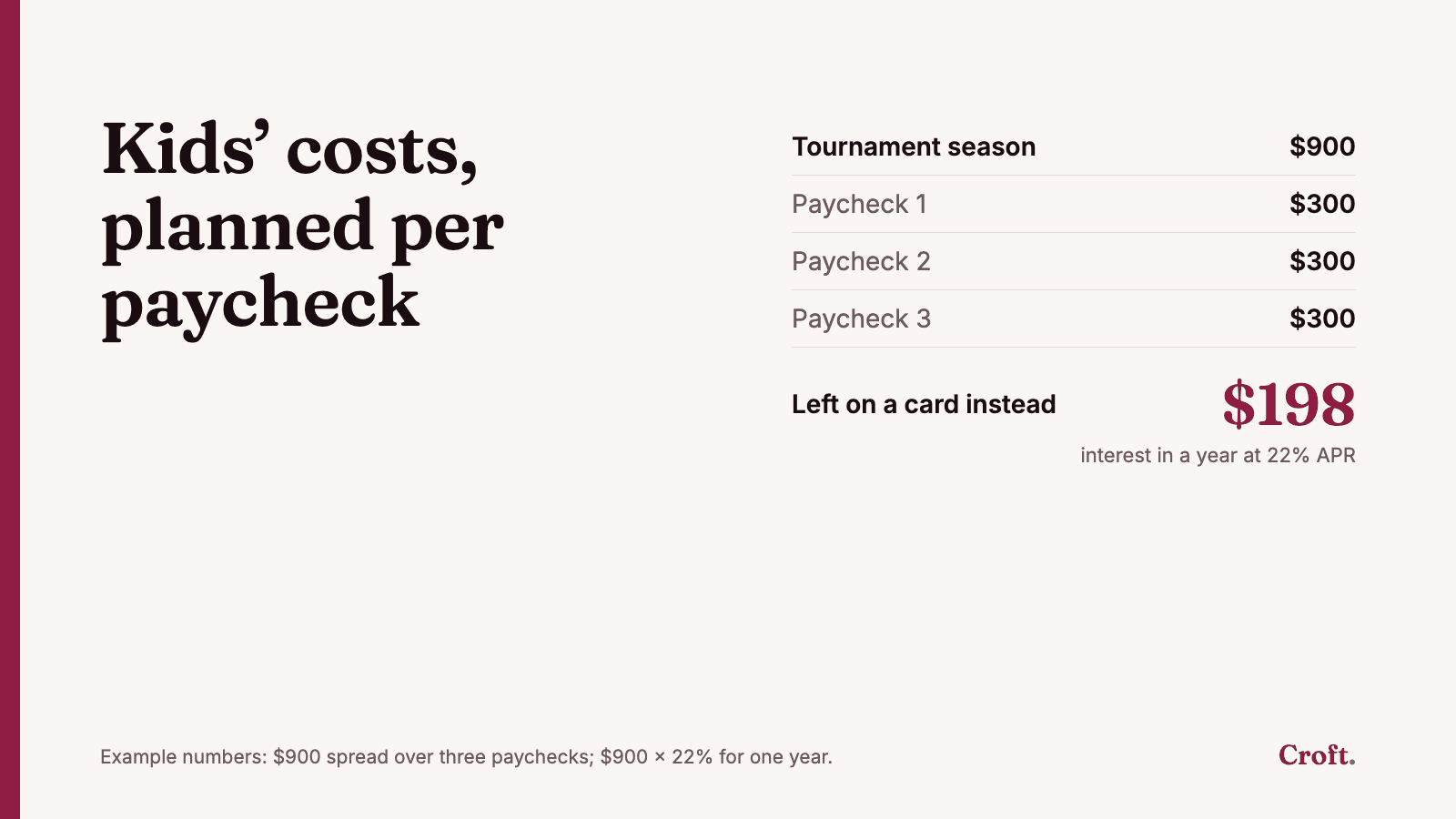
These are example numbers. Say your child's spring tournament season costs $900 all in: a $350 team fee, $150 for a uniform and gear, and $400 for two away weekends of hotel, gas and food. The first payment is due in six weeks. You're paid every two weeks, so three paychecks land before then.
Divide the cost by the paychecks: $900 ÷ 3 = $300 per paycheck.
Example | Set aside | Set aside so far |
|---|---|---|
Paycheck 1 | $300 | $300 |
Paycheck 2 | $300 | $600 |
Paycheck 3 | $300 | $900 |
When the fee is due, the money is already there. No single paycheck had to carry $900 on its own.
If the costs come at different times, it gets easier still. Give each piece its own date: the team fee in March, the first trip in April, the second in May. Each one only needs the paychecks that land before it.
What that same $900 costs on a card
This is an example too. Now say the money wasn't set aside, and the $900 goes on a credit card at 22% APR. That's close to typical. In the third quarter of 2026, the average rate on credit card accounts that were charged interest was 22.36%, according to the Federal Reserve. [[3]](https://www.federalreserve.gov/releases/g19/current/default.htm)
Here's what the $900 costs if it stays on the card for a full year with no payments:
The simple math: $900 × 22% = $198.
How cards usually work: many cards figure interest daily and add it to the balance, so you also pay interest on the interest. Compounded daily, $900 at 22% for a year comes to about $221 in interest.
Paying it off steadily helps, but it isn't free. Pay the same amount each month for 12 months, and the payment is about $84.23. Over the year, that's about $110.82 in interest.
(These are example numbers. Your card's rate, fees, grace period and minimum payment will change the exact cost.)
So the same season costs $110 to $221 more on a card. Same tournament, same uniform, same hotel. The interest bought nothing.
Interest is the killer
Interest is the cost that takes from everything else. Every dollar that goes to interest is a dollar that doesn't go to college, retirement or a family trip.
And kid costs don't happen once. There's a spring season and a fall season, back-to-school in August and the holidays in December. If each one lands on a card, the interest stacks, year after year.
That's why the order matters:
Plan the known costs first, so they stop landing on a card.
Pay down your highest-rate debt next. It's the most expensive money you have.
Then start saving as early as you can for the bigger goals that come later, like college and retirement. Money that isn't going to interest is money that can work for your family.
You don't have to finish step 2 to start step 1. Planning the next season is how you stop adding to the balance while you pay it down.
Common kid costs by month and season
Every school and league runs on its own calendar, so treat this as a checklist, not a schedule. Circle the ones that apply to your family and write in your own dates.
When | Common kid costs |
|---|---|
January–February | Spring sports sign-ups and deposits, winter activity fees, early summer camp sign-ups |
March–May | Spring season fees, uniforms, tournament travel, spring school photos, field trips, end-of-year teacher gifts, summer camp balances |
June–July | Summer camps, summer child care, summer leagues |
August–September | Back-to-school supplies, clothes and shoes, school fees, fall sports sign-ups and uniforms, fall school photos |
October–November | Fall tournament travel, Halloween costumes, winter sports sign-ups |
December | Holiday gifts and travel, child care over winter break |
All year | Child care or tuition every month, birthdays (your kids' and the parties they're invited to), lessons, gear they outgrow |
How to set it up
You only need a pen, last year's bank and card statements, and about 30 minutes.
List the dates. Go through the next 12 months. For each kid cost, write the amount and the date it's due. Last year's statements are a good guide. A rough number is fine; fix it when the real bill comes.
Divide by the paychecks before each date. Take the cost and divide it by the number of paychecks left before it's due. That's your set-aside. Earlier is easier: $900 over three paychecks is $300 each, but over one paycheck it's all $900.
Treat monthly costs like any other bill. Child care or tuition on the same date every month is a regular bill. Tie it to the paycheck that lands before it.
Keep a cushion. Leave a buffer in checking for the costs you can't date: the lost retainer, the extra tournament, the field trip form that came home today. Once your cushion and your dated kid costs are covered, put what's left toward your highest-rate debt.
Change it when the dates change. The team makes playoffs. Camp adds a week. Update the date or the amount, and the plan follows.
When it's not enough
Some seasons won't fit, even with a plan. That's not a failure. Kids cost money, and some years are heavier than others. Here are ways to step down without stepping out:
Cover the must-pays first. Housing, utilities, food and the minimum on every debt come before any season fee.
Pick a smaller version for one season. A rec league instead of the travel team. One away tournament instead of three. Home games only this spring.
Ask before the due date. Some leagues, schools and camps offer payment plans, sibling discounts or scholarships. It's an easier question to ask a month early than a day late.
Buy used and pass things down. Cleats, uniforms and gear get outgrown fast. Team swaps and hand-me-downs count.
Pause one set-aside, not a bill. If a paycheck is short, skip the holiday set-aside this once and pick it back up next payday.
Skip the quick fixes. Pay advances, cash-advance apps and pay-later plans move this cost into a future paycheck. That can make the next season tight too.
Saying "not this season" to your kid isn't a failure either. It's a choice you made on purpose, with a plan behind it.
The short version
Most kid costs aren't random. They come on dates you can see coming. List them with amounts and dates, divide each one by the paychecks before it's due, and keep a cushion for the rest. A $900 season planned over three paychecks is $300 at a time. The same $900 left on a card at 22% for a year can cost about $221 in interest.
Plan the known costs, pay down your highest-rate debt, then save as early as you can. Every dollar that stays out of interest goes back to your family.
Sources:
Board of Governors of the Federal Reserve System, Economic Well-Being of U.S. Households in 2025, May 2026, "Living Arrangements and Care Work," figure 13 (median monthly childcare and housing payments; survey fielded October 2025).
Aspen Institute Project Play, Project Play survey: Family spending on youth sports rises 46% over five years, March 3, 2025 (survey of 1,848 youth sports parents, November–December 2024).
Board of Governors of the Federal Reserve System, Consumer Credit – G.19, released November 6, 2026, "Terms of Credit," credit card plans, accounts assessed interest, 2026 Q3.