Scared to look at your bank balance? How to start, one small step at a time
Not wanting to look at your bank balance is common, and it makes sense. Not looking doesn't make the worry go away, though. Here's why looking feels so hard, a simple 7-day plan for a first look, and kind words to say to yourself along the way.

Not wanting to look at your bank balance is common, and it makes sense. Your mind is trying to keep you away from bad news. The trouble is that not looking doesn't make the worry go away. It gets easier with small, regular looks, and you can start this week.
This post explains why looking feels so hard. Then it gives you a simple 7-day plan for a first look, and some kind words to say to yourself along the way.
Why looking feels so hard
Researchers have a name for this. They call it the ostrich effect, after the old story that an ostrich hides its head in the sand. (Real ostriches don't do that. People do, a little.)
In a 2009 study, researchers looked at how often investors checked their accounts. People checked more often when the stock market was going up. They checked less when it was flat or going down. The researchers said people "put their heads in the sand" when the news might be bad [1].
A later study tracked daily logins to investment accounts. Logins fell by 9.5% after the market went down [2].
This doesn't only happen with stocks. A 2017 review of the research found that people often avoid information "even when it is useful, free" and could help them decide better. The authors gave an example that may sound familiar. If you know your bank account is low, "you might still choose not to log on to your bank's website" and look at your balance [3].
So if you've been avoiding your bank app, you're not lazy and you're not "bad with money." You're doing a very human thing.
You're not the only one
Money worry is very common in the U.S. right now.
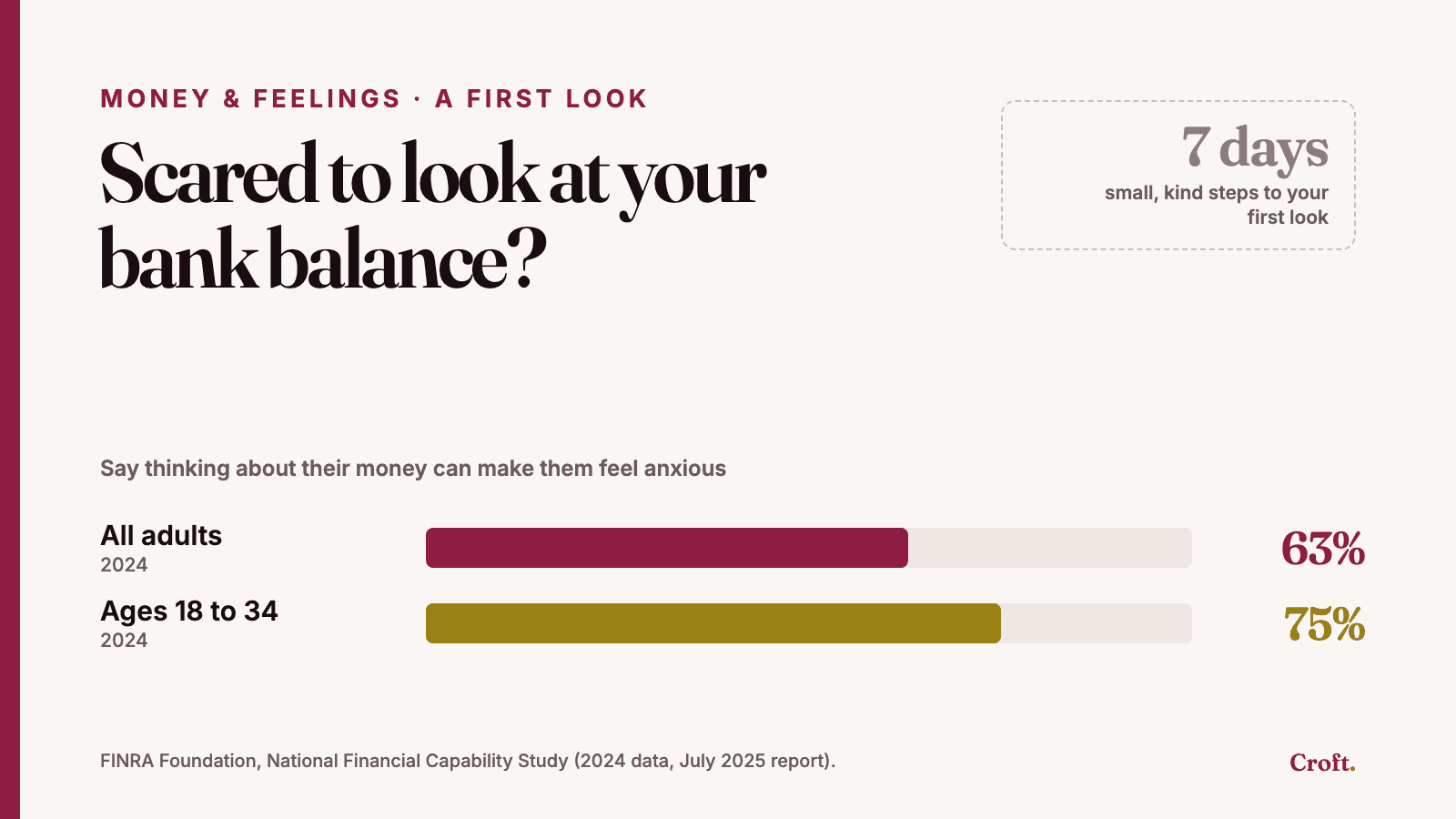
In a large national survey from 2024, 63% of adults agreed that thinking about their personal finances can make them feel anxious. That's up from 56% in 2021 and 53% in 2018 [4].
It was even higher for younger adults. 75% of people ages 18 to 34 said so [4].
In the American Psychological Association's 2026 stress survey, 71% of adults said money is a significant source of stress in their lives. 77% said the same about the cost of living, like rent, groceries and child care [5].
In the Federal Reserve's latest survey, from late 2025, 19% of adults said they were "just getting by." Another 8% said they were "finding it difficult to get by" [6].
Agree
Show data
| Agree | |
|---|---|
| All adults, 2018 | 53% |
| All adults, 2021 | 56% |
| All adults, 2024 | 63% |
| Ages 18 to 34, 2024 | 75% |
If your stomach drops when you think about your balance, a lot of people know that feeling.
Worry takes up room in your head
Money worry doesn't just feel bad. It can make it harder to think.
In a 2013 study, researchers got people thinking about money problems. Then they gave them some thinking tests. People with less money did worse on the tests after thinking about money. People with more money did not [7].
The same team also studied farmers before and after harvest. The same farmer did worse on thinking tests before harvest, when money was tight, than after harvest, when it wasn't. The researchers think money worries "consume mental resources," which leaves less room for everything else [7].
That's why a wall of numbers can feel like too much. It isn't a flaw in you. Worry is already using up some of your attention. It helps to make each look small and simple.
Be kind to yourself first
Many people feel shame about money. Shame makes us want to hide, and hiding is what the ostrich effect is.
Being hard on yourself can feel like the way to change. Research points the other way. In one set of studies, people were asked to be kind to themselves after a failure. They spent more time studying for a hard test after doing badly on it the first time. They were also more motivated to fix a weakness [8].
This is called self-compassion. It means treating yourself the way you'd treat a good friend who's having a hard time. Psychologist Kristin Neff, who studies it, describes three parts [9]:
Kindness instead of judging. Talk to yourself gently.
Remembering you're not alone. Everyone struggles sometimes. You saw the numbers above.
Noticing your feelings without letting them take over. "This is hard right now" is enough.
Small steps that help
These ideas come from research on habits, fear and feelings. None of them asks you to fix everything at once.
1. Make an "if-then" plan
An if-then plan says when and where you'll do something. For example: "If it's Sunday after breakfast, then I'll open my bank app at the kitchen table." A review of 94 studies found that plans like this helped people reach their goals more often. The effect was medium to large, which is a lot for a habit tip [10].
2. Face it a little at a time
Therapists who treat anxiety often use exposure therapy. That means facing a fear on purpose, so a person can get back to things they've been avoiding [11]. You can use a gentle version on your own. Start with a look so small it feels almost silly. Then make it a little bigger each time.
3. Name the feeling
Before you look, say what you feel: "I feel scared," or "I feel embarrassed." In a brain-scan study, putting feelings into words lowered the response of the brain's alarm center to upsetting pictures [12]. Naming a feeling won't make it vanish. But it can make it easier to keep going.
4. Let the default do the work
A default is what happens if you don't choose anything. When one large company started signing new workers up for its retirement plan on its own (they could still opt out), a lot more people joined the plan [13]. You can use defaults for yourself too. Check if your bank app offers a low-balance alert or a weekly balance email. Then the information comes to you, and you don't have to decide to go get it.
5. Look with someone you trust
Sit with a partner, a friend or a family member while you open the app. They don't need to fix anything. They're just there. If that feels like too much, tell them when you're going to look, and text them after.
6. Count the small wins
Looking at your balance for 30 seconds is a win. So is reading one bill. Write it down, or tell someone. You're teaching yourself that looking is safe.
A 7-day "first look" plan
Each step takes 10 minutes or less. If a day feels like too much, repeat the day before. That still counts.
Day 1: Pick your time. Write an if-then plan: "If it's [time] at [place], then I'll open my bank app." Don't look yet.
Day 2: Look at one number. Open the app and read your balance. That's it. Close the app. Say out loud how you feel.
Day 3: Look again. Read the balance and write it on paper. Notice that you've now done this twice.
Day 4: Read the last week. Scroll through the last 7 days of spending. Just read it. No grading yourself.
Day 5: List what's coming. Write down the bills due before your next payday, and about how much each one is.
Day 6: Do one small thing. Turn on a balance alert, call one company about a due date, or move $5 to savings. Pick just one.
Day 7: Look back. Notice what you did this week. Then pick one time each week for a short check-in, and write it as an if-then plan.
After the first week, a weekly look is a good place to start. Some people like a quick daily look once it stops feeling scary.
What to say to yourself
Try one of these before you look, or while you look:
"This is just information. It's not a grade."
"I'm looking because I care about myself."
"Lots of people feel this way. I'm not the only one."
"Whatever the number is, I can handle one next step."
"I don't have to fix it all today."
"I looked. That's the hard part."
When to get more help
Sometimes money stress is too big to handle alone. That's OK. Here are places to turn.
A financial therapist helps with the feelings and the habits around money. The Financial Therapy Association has a directory to find one [14].
A nonprofit credit counselor can help you manage debt and look at options like a debt management plan. You can connect with one through the National Foundation for Credit Counseling (NFCC) [15].
If you're in crisis, or money worry has turned into thoughts of hurting yourself, call or text 988 in the U.S. The 988 Suicide & Crisis Lifeline is free, confidential and open 24/7 [16].
How Croft can help
Croft is a planning tool. It isn't therapy, and it doesn't treat anxiety. But it is built to make looking at your money a smaller, clearer job.
A plan, not a pile. Instead of a long list of transactions, Croft plans each paycheck: bills covered, a cushion kept, and what's safe to pay extra. The number updates right away whenever something changes.
A short morning email. It tells you if something needs you today and what's coming up, like a bill due this week. On a quiet day it says you're on track. It leaves out balances and amounts, except on payday. You can turn it off in Settings.
"I paid this." When you send a payment, tap "I paid this." Croft counts the money as on its way out right now, so you don't have to wonder if it's already counted. It clears on its own when your bank posts it.
Ask Croft. Ask questions about your money in plain words. Ask Croft is built to take its numbers from your accounts and its own calculator, not to guess.
The short version
Avoiding your balance is common, and it makes sense. Not looking keeps the worry running in the background. Make each look small, planned and kind. Name the feeling, look with someone if it helps, and count every look as a win. Start with one number on Day 2.
Sources
Karlsson, N., Loewenstein, G., and Seppi, D. "The ostrich effect: Selective attention to information." Journal of Risk and Uncertainty 38 (2009): 95–115. https://doi.org/10.1007/s11166-009-9060-6 (author copy: https://www.cmu.edu/dietrich/sds/docs/loewenstein/OstrichEffect.pdf)
Sicherman, N., Loewenstein, G., Seppi, D. J., and Utkus, S. P. "Financial Attention." Review of Financial Studies 29, no. 4 (2016): 863–897. https://doi.org/10.1093/rfs/hhv073
Golman, R., Hagmann, D., and Loewenstein, G. "Information Avoidance." Journal of Economic Literature 55, no. 1 (2017): 96–135. https://doi.org/10.1257/jel.20151245 (author copy: https://www.cmu.edu/dietrich/sds/docs/loewenstein/InfoAvoidance.pdf)
FINRA Investor Education Foundation, "Financial Capability in the United States: Results from the FINRA Foundation's National Financial Capability Study," 6th edition (July 2025; survey fielded June–October 2024). https://www.finrafoundation.org/sites/finrafoundation/files/2025-07/NFCS-Report-Sixth-Edition-July-2025.pdf
American Psychological Association, "Stress in America 2026: The stress of uncertainty" (October 2026; Harris Poll survey of 3,132 U.S. adults, July 29 – August 24, 2026). https://www.apa.org/pubs/reports/stress-in-america/2026/full-report.pdf
Board of Governors of the Federal Reserve System, "Economic Well-Being of U.S. Households in 2025," Overall Financial Well-Being (May 2026). https://www.federalreserve.gov/publications/2026-economic-well-being-of-us-households-in-2025-overall-financial-well-being.htm
Mani, A., Mullainathan, S., Shafir, E., and Zhao, J. "Poverty impedes cognitive function." Science 341, no. 6149 (2013): 976–980. https://pubmed.ncbi.nlm.nih.gov/23990553/
Breines, J. G., and Chen, S. "Self-compassion increases self-improvement motivation." Personality and Social Psychology Bulletin 38, no. 9 (2012): 1133–1143. https://pubmed.ncbi.nlm.nih.gov/22645164/
Neff, K. "What is self-compassion?" Self-Compassion.org. https://self-compassion.org/what-is-self-compassion/
Gollwitzer, P. M., and Sheeran, P. "Implementation intentions and goal achievement: A meta-analysis of effects and processes." Advances in Experimental Social Psychology 38 (2006): 69–119. https://kops.uni-konstanz.de/entities/publication/2e749bfb-8533-437c-8203-7e788c910c5f
National Institute of Mental Health, "Panic Disorder: When Fear Overwhelms" (revised 2025). https://www.nimh.nih.gov/health/publications/panic-disorder-when-fear-overwhelms
Lieberman, M. D., et al. "Putting feelings into words: affect labeling disrupts amygdala activity in response to affective stimuli." Psychological Science 18, no. 5 (2007): 421–428. https://pubmed.ncbi.nlm.nih.gov/17576282/
Madrian, B. C., and Shea, D. F. "The Power of Suggestion: Inertia in 401(k) Participation and Savings Behavior." NBER Working Paper 7682 (2000). https://www.nber.org/papers/w7682
Financial Therapy Association, "Find a Therapist." https://financialtherapyassociation.org/financial-therapist-directory/
National Foundation for Credit Counseling. https://www.nfcc.org/
988 Suicide & Crisis Lifeline. https://988lifeline.org/