Buy now, pay later for the holidays: when it helps and when it hurts
Pay in 4 can be a fair deal, or it can land in rent week and set off a bank fee. Here's when buy now, pay later helps, when it hurts, a quick checklist before you click, and how to plan each payment into your paychecks.

Black Friday is Friday, November 27. At almost every checkout, you'll see a button that says something like "Pay in 4." It can feel like a gift: take it home now, pay a little at a time.
Sometimes it really does help. Other times, those small payments land in the same week as rent, and a $100 payment turns into a $35 bank fee. This post shows you how to tell the two apart before you click, and how to plan the payments into your paychecks.
A lot of holiday shopping goes on "pay later"
Buy now, pay later (BNPL) is a big part of the holidays now.
Last holiday season (November and December 2025), shoppers used BNPL for $20 billion in online spending. That was a record, up from $18.2 billion the season before [1] [2].
For this season, Adobe expects $21.3 billion. It expects $807 million on Black Friday alone and $1.09 billion on Cyber Monday [3].
A CFPB study found that in 2021 and 2022, the number of BNPL loans people had going at once rose all year, then spiked "between Black Friday and Christmas Eve" [4].
Billions of dollars
Show data
| Billions of dollars | |
|---|---|
| 2024 holiday season | 18.2 |
| 2025 holiday season | 20 |
| 2026 season (Adobe forecast) | 21.3 |
None of this means you did something wrong if you use it. It just means the holidays are when these payments pile up fastest.
What buy now, pay later is
There are two main kinds.
Pay in 4. You split a purchase into four equal payments. The first one is due when you check out. The other three come out every two weeks, so you're done in about six weeks [5]. Pay in 4 usually charges no interest. Klarna, Afterpay, Affirm and PayPal all describe their pay-in-4 plans as interest-free or 0% APR [6] [7] [8] [9].
Monthly plans. These are longer loans paid once a month, often for bigger buys. They can charge interest. For example, Affirm says its monthly plans can cost 0% to 36% APR, based on your credit [8]. APR is the yearly cost of borrowing. So read the screen closely. "Pay over time" doesn't always mean "free."
In most cases, the payments come out of your bank account or card on their own. That's autopay. It's handy, but it's also where a lot of the trouble starts.
When it can help
Pay in 4 can be a fair deal when a few things are true:
It's 0% and you pay on time. Then it costs the same as paying in cash, just spread out.
Your pay is steady. You know when your next three paychecks are coming and about how much they'll be.
It's one plan at a time. One $100 payment every two weeks is easy to track. Four plans at once are not.
It's something you'd buy anyway. A gift you already planned for, not an extra just because the payment looks small.
In the Federal Reserve's latest survey, the top reason people gave for using BNPL was that they "wanted to spread out payments" (31% of users). The next was "only way I could afford it" (29%) [10]. If it's the only way you can afford something, that's a sign to slow down and look at your next few paychecks first.
When it hurts
Stacking plans
Each plan looks small. Together, they can take a big bite out of every paycheck. In 2022, about 63% of BNPL borrowers had more than one loan going at the same time at some point in the year. 33% had loans going at more than one company [4]. The CFPB calls this "loan stacking." In 2022, it also said BNPL lenders had "no visibility" into your loans at other BNPL companies. So no one is adding them up for you [5].
A payment lands in rent week
Pay in 4 runs on a two-week clock. Your rent and bills don't. Sooner or later, a payment lands in a week that's already tight. That's when the next problem shows up.
An overdraft fee on top
If autopay pulls money your account doesn't have, your bank may charge an overdraft or NSF fee. In the Fed's survey, 11% of BNPL users said a BNPL payment caused an overdraft or NSF fee from their bank in the past year [10]. In 2023, the median overdraft fee at large banks and credit unions was $35 [11].
Even companies that don't charge late fees can't stop your bank from charging one. PayPal says plainly that your bank "may charge you an NSF or other fee" if a payment is returned [9]. Klarna's terms say that if a payment fails, it can try again up to two more times [6].
Late fees
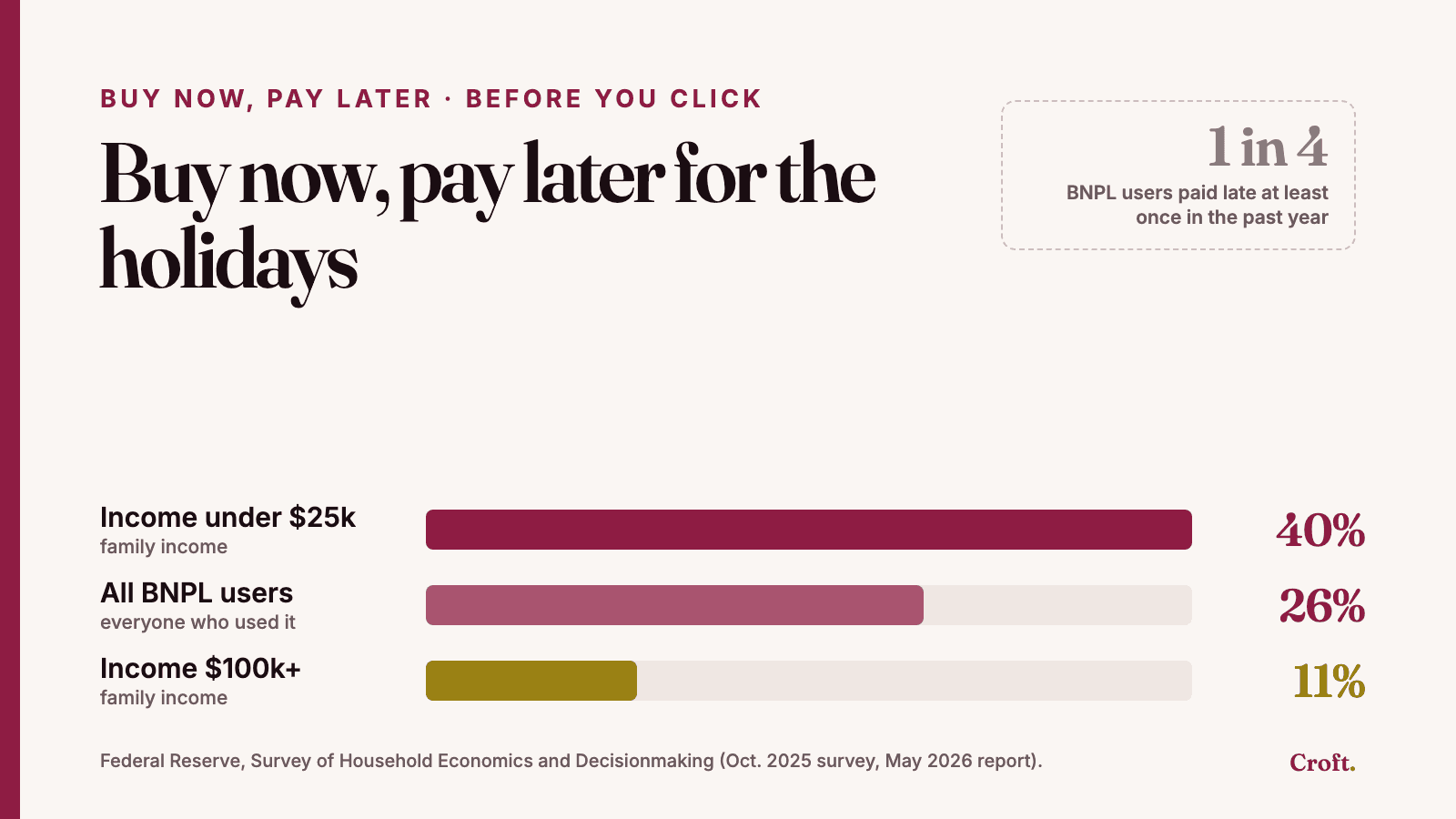
Paying late is common. In late 2025, about 1 in 4 BNPL users (26%) said they paid late in the past year. That rose to 40% for people earning under $25,000 [10].
Paid late
Show data
| Paid late | |
|---|---|
| All BNPL users | 26% |
| Income under $25,000 | 40% |
| $25,000 to $49,999 | 33% |
| $50,000 to $99,999 | 25% |
| $100,000 or more | 11% |
Late fees depend on the company:
Company | Late fee on pay in 4 |
|---|---|
Klarna | Up to $7 if a payment is 10 days late, no more than 25% of the order in total [6] |
Afterpay | Up to $8 per missed payment, no more than 25% of the order in total [7] |
Affirm | Says "You'll never pay late fees" [8] |
PayPal Pay in 4 | Says it doesn't charge late or NSF fees [9] |
Fees can change, so check the terms on the screen before you agree.
Returns that keep charging you
Holiday gifts get returned. With BNPL, a return doesn't always stop the payments right away. Afterpay says your "payment schedule will continue until the merchant processes the refund" [12]. For returns by mail, it lets you push your next payment back up to two weeks, once per order [13]. PayPal says to keep paying "even if you are expecting a refund" [14]. In 2021, about 1 in 7 BNPL loans (13.7%) had at least part of the order returned [5].
So if you might return it, plan to keep paying until the refund shows up.
Your credit report
BNPL is starting to show up on credit reports. Affirm began reporting all of its loans, including pay in 4, to Experian in April 2025 and to TransUnion in May 2025. Affirm said these loans wouldn't count in traditional credit scores "in the near term" [15] [16]. In June 2025, FICO announced its first credit scores that include BNPL data [17].
Many users aren't sure how this works. In the Fed's survey, 53% of BNPL users thought on-time payments help their credit score, which isn't always true [10]. The safe way to think about it: don't count on BNPL to build your credit, and don't count on a missed payment staying hidden.
Fewer federal protections than a credit card
In 2024, the CFPB said BNPL lenders had to follow some credit card rules, like looking into disputes and crediting refunds [18]. In May 2025, it withdrew that rule [19]. So your rights depend more on each company's own terms.
Before you click: a quick checklist
Is it really 0%? Look for "0% APR." If you see an APR above 0%, it's a loan with interest.
When is each payment due? Write down all four dates.
What else comes out that week? Check each date against rent, your car payment and other bills.
What's your lowest point before each payday? If any payment would push your balance close to $0, wait or pick something smaller.
How many plans do you already have? Add up every payment due in the next six weeks, at every company.
What's the late fee? Read it on the screen.
Might you return it? If so, plan to keep paying until the refund comes through.
Plan it into your paychecks: an example
Here's a made-up example to show how timing changes things.
Sam takes home $1,300 every other Friday. Rent is $1,000, due on the 1st. Sam spends about $40 a day on food, gas and everything else. Sam wants a $400 gift. With pay in 4, that's $100 at checkout, then $100 every two weeks.
Option A: buy on Black Friday (Nov 27). The first $100 comes out that day. Rent comes out on Tuesday, Dec 1. Payday isn't until Friday, Dec 4. By Thursday, Sam's balance is −$40. That's an overdraft, and maybe a $35 fee.
Option B: buy on payday (Dec 4). Same gift, same $400. Before payday, Sam's lowest point stays at $60. It's tight, but it's not below zero. And because Sam bought on payday, every payment after that also lands on a payday: Dec 18, Jan 1 and Jan 15.
Show data
| Days after Black Friday (Nov. 27) | Bought on Black Friday | Bought on payday, Dec. 4 |
|---|---|---|
| 0 | $1,200 | $1,300 |
| 1 | $1,160 | $1,260 |
| 2 | $1,120 | $1,220 |
| 3 | $1,080 | $1,180 |
| 4 | $40 | $140 |
| 5 | $0 | $100 |
| 6 | −$40 | $60 |
| 7 | $1,220 | $1,220 |
| 8 | $1,180 | $1,180 |
| 9 | $1,140 | $1,140 |
| 10 | $1,040 | $1,040 |
| 11 | $1,000 | $1,000 |
| 12 | $960 | $960 |
| 13 | $920 | $920 |
| 14 | $780 | $880 |
| 15 | $740 | $840 |
| 16 | $700 | $800 |
| 17 | $660 | $760 |
| 18 | $500 | $600 |
| 19 | $460 | $560 |
| 20 | $420 | $520 |
| 21 | $1,680 | $1,680 |
| 22 | $1,640 | $1,640 |
| 23 | $1,600 | $1,600 |
| 24 | $1,560 | $1,560 |
| 25 | $1,520 | $1,520 |
| 26 | $1,480 | $1,480 |
| 27 | $1,440 | $1,440 |
| 28 | $1,300 | $1,400 |
| 29 | $1,260 | $1,360 |
| 30 | $1,220 | $1,320 |
| 31 | $1,180 | $1,280 |
| 32 | $1,140 | $1,240 |
| 33 | $1,100 | $1,200 |
| 34 | $1,060 | $1,160 |
| 35 | $1,320 | $1,320 |
| 36 | $1,280 | $1,280 |
| 37 | $1,240 | $1,240 |
| 38 | $1,200 | $1,200 |
| 39 | $1,160 | $1,160 |
| 40 | $1,120 | $1,120 |
| 41 | $1,080 | $1,080 |
| 42 | $940 | $1,040 |
The gift didn't change. Only the timing did. Waiting one week, if the deal allows it, kept Sam out of the red. One more tip: if a payment lands on payday, check that your pay usually arrives before the payment comes out.
If you can't wait, other options are a smaller gift, or moving some spending out of rent week.
Questions people ask
Does buy now, pay later hurt your credit?
It can show up now. Affirm reports all of its loans, including pay in 4, to Experian and TransUnion [15] [16]. FICO has made credit scores that include BNPL [17]. Rules differ by company, so check the terms.
Is pay in 4 really free?
It's free if it's 0% APR and you pay every payment on time. Late fees, and bank fees from a failed autopay, are what make it cost more.
What happens if I miss a payment?
It depends on the company. Klarna and Afterpay may charge a late fee [6] [7]. Afterpay says your account is suspended until late payments are paid [20]. Your bank may also charge a fee if autopay fails. If you see a payment you can't cover coming, contact the company before the due date and ask what your options are.
Do I still pay if I return the item?
Often, yes, until the store processes your refund [12] [14]. Keep your receipt and the return tracking number.
How many BNPL plans is too many?
There's no magic number. A good test: add up every payment due in the next six weeks. If they don't fit into your paychecks after rent and bills, it's too many.
The short version
Pay in 4 can help when it's 0%, your pay is steady and you have one plan at a time. It hurts when plans stack up, a payment lands in rent week, or autopay hits an empty account. Before you click, write down all four dates and check your lowest point before each payday. Sometimes the best move is to buy on payday instead.
Sources
Adobe, "Adobe: Holiday Shopping Season Drove a Record $257.8 Billion Online with Consumers Embracing Generative AI Tools" (2025 holiday season results, released January 2026). https://news.adobe.com/news/downloads/pdfs/2026/01/010726-2025-holiday-shopping-season.pdf
Adobe, "Adobe: Holiday Shopping Season Drove a Record $241.4 Billion Online and Rising 8.7% YoY" (2024 holiday season results, January 7, 2025). https://www.businesswire.com/news/home/20250107759280/en
Adobe, "Adobe: U.S. Holiday Shopping Season to Hit Record $275.1 Billion Online, Rising 6.7% YoY" (2026 forecast, September 28, 2026). https://news.adobe.com/news/downloads/pdfs/2026/09/adi-holiday-forecast-release-9-28.pdf
Consumer Financial Protection Bureau, "Consumer Use of Buy Now, Pay Later and Other Unsecured Debt" (January 13, 2025). https://files.consumerfinance.gov/f/documents/cfpb_BNPL_Report_2025_01.pdf
Consumer Financial Protection Bureau, "Buy Now, Pay Later: Market Trends and Consumer Impacts" (September 2022). https://files.consumerfinance.gov/f/documents/cfpb_buy-now-pay-later-market-trends-consumer-impacts_report_2022-09.pdf
Klarna, "Pay in 4 Agreement" (U.S., published June 3, 2026). https://cdn.klarna.com/1.0/shared/content/legal/terms/0/en_us/sliceitinx
Afterpay, "Is there a cost to using Afterpay?" (U.S. help center, accessed October 30, 2026). https://www.afterpay.com/en-US/help/900005359783-Is-there-a-cost-to-using-Afterpay
Affirm, "Why Affirm" (accessed October 30, 2026). https://www.affirm.com/how-it-works/why-affirm
PayPal, "What is Pay in 4?" (U.S. help center, accessed October 30, 2026). https://www.paypal.com/us/cshelp/article/what-is-pay-in-4-help463
Board of Governors of the Federal Reserve System, "Economic Well-Being of U.S. Households in 2025" (May 2026; survey fielded October 2025). https://www.federalreserve.gov/publications/files/2025-report-economic-well-being-us-households-202605.pdf
Consumer Financial Protection Bureau, "Overdraft and Nonsufficient Fund Fees: Insights from the Making Ends Meet Survey and Consumer Credit Panel" (December 2023). https://files.consumerfinance.gov/f/documents/cfpb_overdraft-nsf-report_2023-12.pdf
Afterpay, "My order has been returned/canceled. Why am I still being charged?" (accessed October 30, 2026). https://www.afterpay.com/en-US/help/20247554161945-My-order-has-been-returned-canceled-Why-am-I-still-being-charged
Afterpay, "I am expecting a refund. Can I push back my next payment so I am not charged?" (accessed October 30, 2026). https://www.afterpay.com/en-US/help/20248178273817-I-am-expecting-a-refund-Can-I-push-back-my-next-payment-so-I-am-not-charged
PayPal, "Questions about Pay in 4 repayments" (U.S. help center, accessed October 30, 2026). https://www.paypal.com/us/cshelp/article/questions-about-pay-in-4-repayments---help1099
Affirm, "Affirm Expands Credit Reporting with Experian to Include All Pay-Over-Time Products" (March 19, 2025). https://www.businesswire.com/news/home/20250319542289/en/Affirm-Expands-Credit-Reporting-with-Experian-to-Include-All-Pay-Over-Time-Products
Affirm, "Affirm Expands Credit Reporting with TransUnion to Include All Pay-Over-Time Products" (April 22, 2025). https://www.nasdaq.com/press-release/affirm-expands-credit-reporting-transunion-all-pay-over-time-products-2025-04-22
FICO, "FICO Unveils Groundbreaking Credit Scores That Incorporate Buy Now, Pay Later Data" (June 23, 2025). https://investors.fico.com/news-releases/news-release-details/fico-unveils-groundbreaking-credit-scores-incorporate-buy-now
Consumer Financial Protection Bureau, "CFPB Takes Action to Ensure Consumers Can Dispute Charges and Obtain Refunds on Buy Now, Pay Later Loans" (May 22, 2024). https://www.consumerfinance.gov/about-us/newsroom/cfpb-takes-action-to-ensure-consumers-can-dispute-charges-and-obtain-refunds-on-buy-now-pay-later-loans/
Consumer Financial Protection Bureau, "Interpretive Rules, Policy Statements, and Advisory Opinions; Withdrawal," 90 FR 20084 (May 12, 2025). https://www.govinfo.gov/content/pkg/FR-2025-05-12/html/2025-08286.htm
Afterpay, "What happens if I can't make a payment on time?" (accessed October 30, 2026). https://www.afterpay.com/en-US/help/900001507483-What-happens-if-I-can-t-make-a-payment-on-time